REVIEW · THE HAGUE
e-Scavenger hunt Delft: Explore the city at your own pace
Book on Viator →Operated by Qula · Bookable on Viator
Delft turns into a game fast.
This e-scavenger hunt is a self-paced city trail you play on your phone, with riddles and challenges that make you slow down at places you might otherwise breeze past. I like that it’s flexible, so you can start, pause, or stop when your group needs a breather. You’re guided for about two hours through standout spots, but the trail is open all day, with no time limit once you start.
What I liked most is how it nudges you to actually use the streets of Delft as part of the fun. You walk between 12 landmarks—churches, a city hall, a museum stop, monuments, courtyards—and the app keeps the momentum with short tasks and the option to aim for a top score with family or friends. The main drawback is also game-style: if the session times out, you may have to start over even with the same team name.
In This Review
- Quick hits before you go
- A 3-hour Delft game that fits your day
- Price and what you actually get for $37.35
- Meeting at Van Leeuwenhoeksingel and starting the Qula trail
- How the smartphone trail works (and why you can pause)
- The walk itself: pacing, route flow, and what to bring
- Stop-by-stop: from Beestenmarkt to Markt
- Stop 1: Beestenmarkt
- Stop 2: New Church
- Stop 3: Museum Prinsenhof Delft
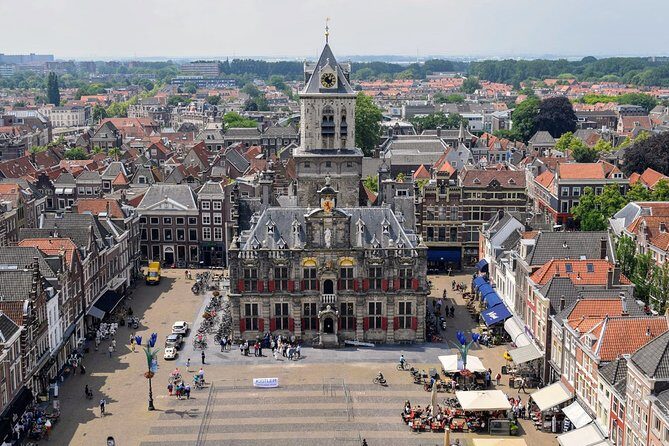
- Stop 4: Stadhuis Delft
- Stop 5: Old Church
- Stop 6: Hugo de Groot Monument
- Stop 7: Bagijnhofpoort
- Stop 8: Vleeshal de Koornbeurs
- Stop 9: Gemeenlandshuis van Delfland
- Stop 10: Vermeer Centrum Delft
- Stop 11: Hot Spot Doelenplein Delft
- Stop 12: Markt
- Scoring, time limits, and keeping your team on track
- Languages, private play, and who this fits best
- Should you book this Delft e-scavenger hunt?
- FAQ
- How much does the e-Scavenger hunt in Delft cost?
- How long does the experience take?
- What language is the trail offered in?
- Is there a fixed start time?
- Is there a time limit once I start?
- What do I need to play?
- Where does the hunt start and end?
- Is it private for my group?
- What are the opening hours?
- What is the cancellation policy?
Quick hits before you go
- Self-guided with no fixed start times: pick your own day and hour
- Phone-based riddles at 12 Delft stops: walk, read, solve, move on
- Pause and stop whenever your group needs it: no forced pace
- No time limit once you begin: your hunt, your timing
- Works in multiple languages: English and more are available
A 3-hour Delft game that fits your day
This trail is built for people who don’t want to lock into a rigid tour schedule. It runs about 3 hours in typical use, but the trail itself doesn’t shove you toward a stopwatch. If your group is chatty, takes longer photo stops, or just likes to wander between clues, you won’t feel like you’re falling behind a guide.
The feel is part walk, part puzzle, part light competition. You solve assignments right where you are, then keep going to the next stop. That makes the experience great for mixed ages and personalities: the person who likes history can still enjoy the landmark stops, and the person who just wants a fun way to explore can stay hooked on solving.
You’re also not tied to a specific start time. The trail is available 24/7, so you can plan it around lunch, weather, or whatever your day in the Delft–The Hague area already looks like.
You can also read our reviews of more city tours in The Hague


Price and what you actually get for $37.35
The price is $37.35 per group, for up to 6 people. That matters because the cost is not per person. Divide it out and you’re looking at roughly $6 per person at full group capacity. Even if you don’t fill all six spots, it’s still a pretty economical way to get a structured walking route without hiring a traditional guide.
What you’re buying isn’t a guided narration. You’re buying a game wrapper that steers you to specific locations and gives you prompts to interact with each spot. That’s the value: the app turns a normal walk around Delft into a sequence of little missions.
One balance point to keep in mind: this is not positioned as a deep dive into historical facts. If what you want most is a fact-packed tour, the riddles may feel more general than you hoped. If your goal is to explore together and have something to do while you walk, it’s a strong fit.
Meeting at Van Leeuwenhoeksingel and starting the Qula trail
You’ll start at Van Leeuwenhoeksingel 42A, 2611 AC Delft, Netherlands, and the activity ends back at that same meeting point. In practical terms, that loop is convenient—you don’t have to worry about end-of-tour transport or figuring out a totally different neighborhood to reach.
Before you head out, you’ll need to rely on your own smartphone. The trail uses a mobile ticket and a free smartphone app you download to play. Smartphone and data aren’t included, so plan for two things: a device you can navigate with one hand (or two, depending on your team setup) and enough connectivity for the app to function smoothly.
The tour is listed as a private activity, meaning only your group plays the trail. That’s helpful if you want a more casual rhythm, like a family team that prefers to discuss clues out loud rather than rush quietly to stay with strangers.
How the smartphone trail works (and why you can pause)
Here’s the core idea: with your booking, you receive an email with instructions for how to play on your smartphone (Android or iPhone compatible). Once you’re at the starting point, you begin your quest through Delft. Then the app directs you from stop to stop, prompting you to solve assignments at each location.
Two features make a big difference for real travel life:
- No time limit for the overall session
You can treat it like a flexible stroll. If you want to spend extra time at one landmark, you can.
- You can play, pause, or stop
This is perfect for groups that need breaks—kids who get restless, adults who want a café stop, or anyone who simply needs to adjust the pace mid-route.
The trail can also include moments where the game feels more urgent. One review mentioned that there can be time limits for certain answers, which adds a little adrenaline without turning the whole walk into a race. If your team likes competition, that’s where it kicks in.
The walk itself: pacing, route flow, and what to bring
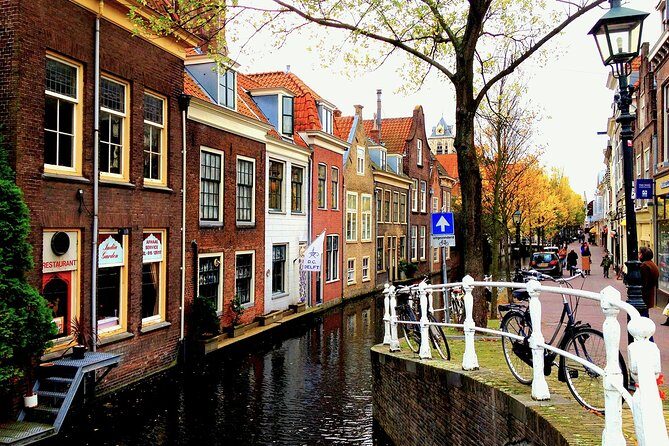
The trail guides you through 12 stops. It’s designed for you to be walking between landmarks rather than hopping around by transit. Since you’ll be moving through a city center, I’d plan on comfortable walking shoes and the usual smart travel basics: phone access, good hydration habits, and a team setup that makes solving easier.
Because the experience depends on your phone, I recommend treating your device like part of your luggage. Keep it charged, and don’t count on the battery life you might get from a quick Google Maps session. The app is doing the heavy lifting for navigation and tasks.
Also, bring your group style into it. If you’re traveling as a team of mixed abilities, assign roles informally: one person reads the prompt, one person checks the map directions, and one person tries the answer. It keeps momentum going even if one person hits a clue that stumps everyone.



Stop-by-stop: from Beestenmarkt to Markt

Below is the route the app takes you through, in order. Think of each stop as a mini “pause point” where you’re not just looking—you’re solving something tied to where you are.
Stop 1: Beestenmarkt
You kick off at Beestenmarkt, a good opening stop because it sets the tone for the game. Expect your first mission to get your team into the rhythm: orient yourself, get comfortable with how the prompts work, and start building that team focus.
Tip: Use this first stop to agree on how you’ll work together. If you decide roles early, the rest of the trail feels smoother.
Stop 2: New Church
Next is the New Church. Since it’s a church stop, your tasks likely feel like they’re asking you to pay attention to specific details around the building area. This is a classic “slow down and look” moment—your phone helps you stay engaged while you scan what’s around you.
Consideration: If your team prefers more straightforward sightseeing, the puzzle format here will determine how much you enjoy the stop.
Stop 3: Museum Prinsenhof Delft
You then reach Museum Prinsenhof Delft. Museum stops are usually where the game can blend landmark recognition with clue-solving. If your group likes culture but hates lectures, this is a way to enjoy a museum setting without committing to a long indoor visit on the spot.
Drawback to note: This kind of stop is still part of a game route. Don’t expect the trail to function like a full museum audio guide.
Stop 4: Stadhuis Delft
After the museum, the app takes you to Stadhuis Delft (the city hall). This stop can feel like a shift: more civic landmark energy, and often the kind of place where visual details help the game along.
I like civic buildings in city games because they give you strong orientation points. You’re less likely to feel lost when the landmark is obvious in front of you.
Stop 5: Old Church
The route continues to Old Church. Two church stops back-to-back can be handy for teamwork, too: people who like comparing architecture styles can do that, while everyone else focuses on answering the prompt.
If you’re traveling with kids, churches can also be an easier sell because the setting looks familiar and “important.”
Stop 6: Hugo de Groot Monument
Then comes Hugo de Groot Monument. A monument stop usually means the app is encouraging you to notice a specific object or name-related detail rather than scanning an entire streetscape. It’s a good break from buildings, because monuments are often clearer targets for puzzles.
Stop 7: Bagijnhofpoort
Next is Bagijnhofpoort. A “poort” (gate/portal) type of stop often works well in a game because it’s distinct in layout. It’s also the kind of location where your team can feel like it found a special corner of the city simply by being directed there.
Stop 8: Vleeshal de Koornbeurs
You then hit Vleeshal de Koornbeurs. This is another name that signals an indoor-style venue (like a hall), so the game approach here often feels like it’s about identifying the place and solving the clue tied to it.
Practical note: If doors or entrances look different from what you expect, don’t panic. Follow what the app leads you toward.
Stop 9: Gemeenlandshuis van Delfland
Stop 9 is Gemeenlandshuis van Delfland. This is a classic “landmark-and-answers” stop. Your team will likely spend a few minutes reading and aligning what the prompt is asking with the location in front of you.
This is a good stage of the trail to regroup. If someone’s stuck on a clue, it’s easy to reset everyone and move on.
Stop 10: Vermeer Centrum Delft
Now you’re at Vermeer Centrum Delft. A center named for Vermeer suggests an arts focus, and this stop can feel like one of the more thematic points of the walk. Even if you don’t go deep into exhibits, it’s a strong landmark anchor for your puzzle route.
Stop 11: Hot Spot Doelenplein Delft
Then the app guides you to Doelenplein Delft—listed as a hot spot. That label hints you’ll likely get a more energetic or more pointed challenge here. This is a good place for your team’s “we’re so close to finishing” energy.
If your group likes scoring, this is the stage where you’ll want to pay attention and make sure you’re not losing points to a missed step.
Stop 12: Markt
Finally, you end at Markt. Markets are great endings for city games because they naturally feel like the “heart” of a place. It’s also a satisfying last stop: you’re back in an area that makes it easy to transition to food, shopping, or just lingering after the hunt.
Scoring, time limits, and keeping your team on track

The trail is built for group fun. You can aim for a top score with family or friends, which is what turns a normal walk into a shared mission. The game doesn’t require you to be competitive, but if your group enjoys it, the scoring helps.
One review called out that while there’s no overall time pressure, some parts can include time limits. That’s a smart mix: you get freedom to wander, but you still get quick bursts where everyone has to focus.
The one caution from that same feedback: if your session times out, you may need to start over even with the same team name. That doesn’t mean the trail is “broken”—it means your phone battery, signal, and app stability matter. If you’re playing on a day with heavy phone use, keep an eye on your connection and battery so you don’t lose momentum.
Languages, private play, and who this fits best

The trail is available in multiple languages, including English (and also German, French, Dutch, Spanish, Italian, and more). That’s a big deal in the Netherlands, where you might otherwise spend energy translating or trying to find an itinerary that matches your group’s comfort level.
It’s also listed as user-friendly for hearing impaired, and it supports service animals. If your group has specific accessibility needs, those details are worth noting because they signal the experience was designed with a broader set of travelers in mind.
Because the activity is private and for a maximum of 6 people, you don’t have to manage a mixed crowd. If you’re traveling as a family, a small group of friends, or even two couples, it’s easier to keep a calm pace while still enjoying the game.
Should you book this Delft e-scavenger hunt?
Book it if you want a fun, structured way to explore Delft on your own schedule. It’s a strong value at $37.35 per group, especially when you fill up to six people. The mix of landmarks and app-guided riddles makes it feel purposeful without locking you into a strict timetable.
I’d skip it (or at least adjust expectations) if your main goal is a fact-heavy historical tour. This trail is more about solving tasks and moving through the city, not delivering a deep, lecture-style explanation at every stop.
If you like playful travel—check your phone for the next mission, walk to a landmark, solve something together—this is a great match. And if your group enjoys friendly scoring, you’ll likely have more fun than you expected from a city walk.
FAQ
How much does the e-Scavenger hunt in Delft cost?
It’s $37.35 per group, for groups of up to 6 people.
How long does the experience take?
The duration is about 3 hours.
What language is the trail offered in?
It’s offered in English, and also in multiple other languages.
Is there a fixed start time?
No. There are no fixed starting times. You choose your own day and time.
Is there a time limit once I start?
No. The trail has no time limit, and you can start, pause, or stop whenever you want.
What do I need to play?
You’ll need a smartphone and data. These are not included.
Where does the hunt start and end?
It starts at Van Leeuwenhoeksingel 42A, 2611 AC Delft, Netherlands and ends back at the same meeting point.
Is it private for my group?
Yes. It’s a private tour/activity and only your group participates.
What are the opening hours?
The trail is available 24/7, from 12:00 AM to 11:59 PM.
What is the cancellation policy?
You can cancel for a full refund if you cancel at least 24 hours in advance. If you cancel less than 24 hours before the start time, the amount paid is not refunded.