REVIEW · AMSTERDAM
Amsterdam: Private City Highlights Tour by Rickshaw
Book on GetYourGuide →Operated by black fox transport tour and hire · Bookable on GetYourGuide
Amsterdam looks different from a rickshaw. This is a smart way to save walking time while still seeing the city’s biggest sights up close, from Dam Square to the Jordaan. I like that you get hotel pickup and drop-off, so you’re not spending your precious first hour hunting down a meeting point.
What really sells this for me is the feel of a private guided ride—you get history and context while you glide past neighborhoods that would be a slog on foot. The only real drawback to plan around is logistics: the rickshaw can’t take wheelchair users, and there are strict limits on bags and the rider’s weight.
In This Review
- Key Points I’d Prioritize
- Why This Rickshaw Tour Works Better Than a Walking Route
- Getting Oriented in Amsterdam-Centrum: Hotel Pickup to Dam Square
- Through the Red-Light District, Chinatown, and the Jordaan Without the Exhaustion
- Nieuwmarkt and Rembrandtplein: The “Everyday City” Beat
- Magere Brug and Museumplein: Bridges and Museum-Centered Amsterdam
- The 2-Hour Add-Ons: Vondelpark, De Gooyer Windmill, and Rembrandt House
- Vondelpark
- De Gooyer Windmill
- Rembrandt House
- De Negen Straatjes and Anne Frank House: Small Streets, Big Meaning
- Crossing Into Jordaan for the Finish
- Price and Value: Is $118 for a Private Rickshaw Worth It?
- Guide Quality and the Little Details That Matter
- Who This Tour Is Best For
- Should You Book This Private Amsterdam Highlights Rickshaw Tour
- FAQ
- How long is the Amsterdam private city highlights rickshaw tour?
- What does the tour cost?
- Where does the tour start and end?
- What are the main highlights you’ll see on the route?
- What extra sights are included if I book the 2-hour tour?
- Does the rickshaw include WiFi?
- What languages do the guides speak?
- Is this tour wheelchair accessible?
- Are luggage or pets allowed?
- What is the weight limit per rickshaw?
Key Points I’d Prioritize
- Hotel pickup and drop-off keeps the tour easy from start to finish.
- More ground than walking means you can hit major sights without burning your legs.
- A professional guide gives you the why behind what you’re seeing, not just the where.
- Route mixes “wow” and “real neighborhood”: Dam Square, Red-Light District, Museumplein, and Jordaan.
- WiFi and onboard speaker make the ride feel less like a cramped commute.
Why This Rickshaw Tour Works Better Than a Walking Route
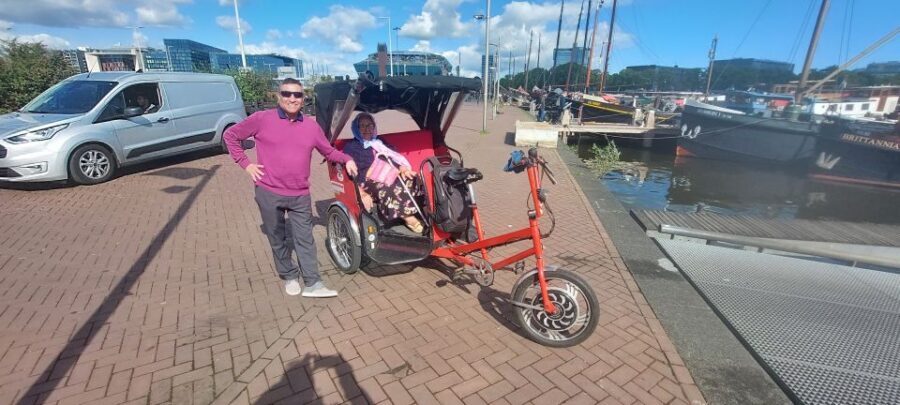
Amsterdam is compact, but it’s also packed. Streets can feel endless when you’re aiming for Dam Square, the Museumplein area, and the canal-side neighborhoods in one day. A bicycle taxi (pedicab style) solves that with simple physics: you can cover distance without spending all day stepping over bridges and canals.
You also get a different angle on the city. From the seat, you naturally slow down mentally. You notice facades, storefronts, and bridge approaches because you’re not rushing. A normal bus tour can feel like a video—this feels more like moving through chapters.
This is a private group experience, aimed at doing a highlights route efficiently. That matters if you want structure (where to go, what to look at) but still prefer a more personal pace than a large group.
Quick practical notes you should know upfront:
- There’s a maximum weight per rickshaw of 500 lb / 230 kg (up to 2 adults and 2 small children under 9).
- No luggage or large bags, and pets aren’t allowed (assistance dogs are the exception).
- It’s not suitable for wheelchair users.
If you’re traveling light and fit within those limits, you’re set up for an easy, high-value city introduction.
You can also read our reviews of more city tours in Amsterdam

Getting Oriented in Amsterdam-Centrum: Hotel Pickup to Dam Square
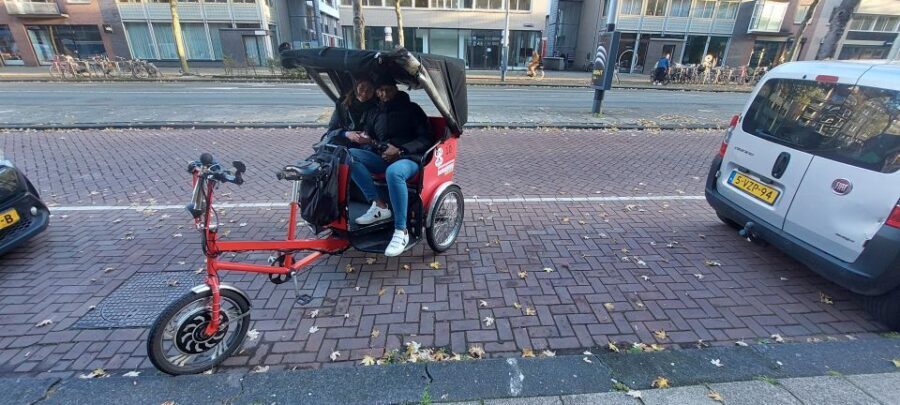
The tour starts with pickup right from your hotel in Amsterdam’s city center (Amsterdam-Centrum). That’s a big deal. In Amsterdam, the fun starts when your legs aren’t already tired, and the day isn’t already chaotic. You avoid the usual scramble of “Where is the meeting point exactly?” and you’re moving within minutes.
From there, the route begins near Dam Square. This is one of those places you’ll recognize immediately from photos—but you also get context fast. Dam Square is tied to the city’s origin story: a dam was built around the Amstel in the 13th century to keep sea water from flooding the area. Standing in that broader square energy is one thing, but passing through and hearing how the city formed gives it a practical backbone.
What I like here is that you’re not just ticking off a landmark. You’re seeing how a place connects to Amsterdam’s survival strategy: water control, trade growth, and then the dense city pattern that still shapes what you see today.
One small “tip” style consideration: Dam Square is busy. A ride helps you see it without turning your tour into a slow, crowded shuffle.
Through the Red-Light District, Chinatown, and the Jordaan Without the Exhaustion
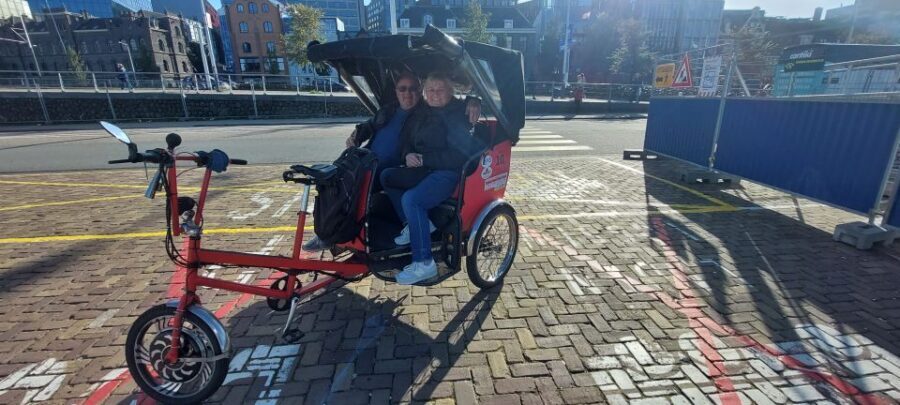
After Dam Square, you move toward the Red-Light District. This is where the tour format really earns its keep. Walking through means you’re constantly navigating tight sidewalks and crowds. On a rickshaw, you can take in what’s around you at a steadier pace.
You’ll get the mood described as racy but friendly, which is a good way to manage expectations. You don’t need to sensationalize it; the point is understanding how the area fits into the city’s history and how Amsterdam deals with tourism, legality, and everyday life all at once.
Then comes Chinatown. Passing through on the route helps you notice the texture changes—different signage, shops, and a distinct local vibe compared with the larger landmark zones. Even if you don’t stop for a meal, you’re getting a feel for Amsterdam’s layers. It’s not just canals and museums; it’s also immigrant neighborhoods, food, and street-level commerce.
Next, you head through the Jordaan. Jordaan is often described in a postcard way, but from the rickshaw you see the practical part: narrow streets, pretty homes, and the way people live and eat around the corners. You end up with a more believable “real neighborhood Amsterdam” impression than you’d get from only museum stops.
If you’re sensitive to the atmosphere of certain streets, you’ll still benefit from the guide’s framing. And because you’re not walking every meter, you can keep your comfort level without skipping the sights.
Nieuwmarkt and Rembrandtplein: The “Everyday City” Beat
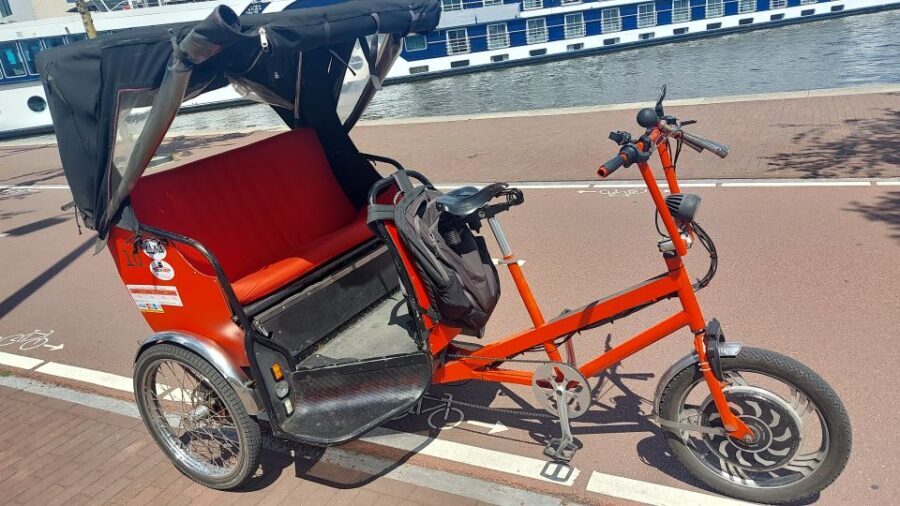
Between the landmark blocks, Nieuwmarkt Square is one of the most useful stops for learning how Amsterdam feels day to day. It’s lively, and it reads like a working public space rather than a single iconic monument. You’ll also pass by Rembrandtplein, known for nightlife. Even if it’s not nighttime when you go, the area’s energy stays in the streets.
This part of the tour gives you something many highlight tours skip: the middle zones. Those are the streets where you’ll later want to wander on your own, because you’ll already know what you’re looking for. You’re not only consuming “top attractions”; you’re building a mental map of neighborhoods.
A practical idea: if you want to plan your next day, pay attention here. After you’ve seen the flow from squares to canals and museum areas, deciding where to eat or stroll becomes easier.
Magere Brug and Museumplein: Bridges and Museum-Centered Amsterdam
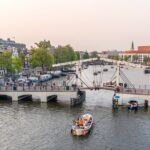
One of the signature moments on this route is Magere Brug—the famous skinny bridge over the Amstel. From the rickshaw, you can take in the approach to the bridge without getting stuck at the worst crossing points. You also learn what you’re looking at in the moment, rather than later from memory.
After that, the tour moves toward Museumplein, where three museum buildings surround a large open area. Even if you don’t go into any galleries (and plenty of people won’t on a highlights tour), this area matters. It’s how Amsterdam shows its “I’m a city of art” identity, and it shapes the flow of people moving through the city.
You also pass by P.C. Hooftstraat, a major shopping street. That’s useful context too: Amsterdam isn’t one single vibe. It has tourist corridors, but it also has upscale retail zones that change the feel of the streets quickly.
If your goal is to understand the city’s layout in a short time, this section is key. You end up knowing where Museumplein sits relative to the canals and the neighborhoods you’ll likely explore later.
You can also read our reviews of more private tours in Amsterdam





The 2-Hour Add-Ons: Vondelpark, De Gooyer Windmill, and Rembrandt House
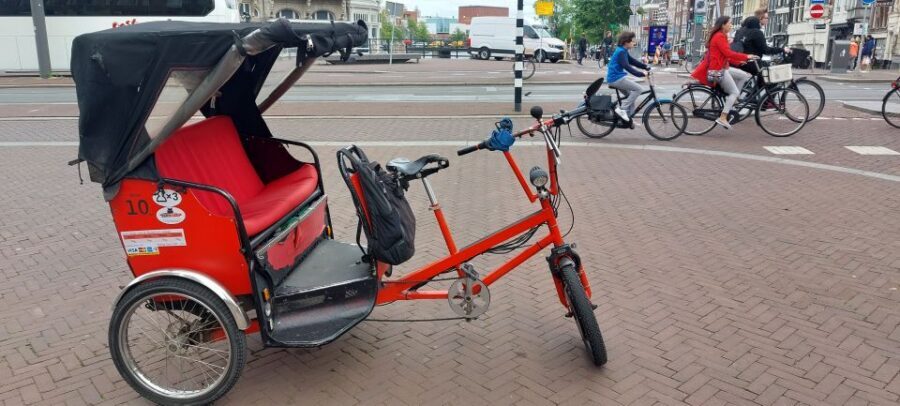
If you book the 2-hour option, you’ll add several extra stops that deepen the “Amsterdam beyond the postcard” side. The extra sights include:
- Vondelpark
- De Gooyer Windmill
- Rembrandt House
Vondelpark
Vondelpark is a major green space. Even without a long walk, seeing it as part of the tour helps you connect Amsterdam’s culture of biking, parks, and city relaxation. You get the idea that people escape the streets without leaving the city.
De Gooyer Windmill
Windmills don’t just belong in the countryside here. De Gooyer Windmill adds that classic Netherlands idea of engineering and water/land management. In a city setting, it’s a reminder that Amsterdam’s water story never disappears—it just changes form as the city modernizes.
Rembrandt House
Rembrandt House connects art and everyday life in a direct way. Instead of talking about a painter as a distant name, you see where he lived, which makes the history feel less abstract.
If you’re choosing between 1 hour and 2 hours, I’d lean longer if:
- you want more variety (park + windmill + historic home), or
- you’d like more chances to ask questions to your guide as you ride.
De Negen Straatjes and Anne Frank House: Small Streets, Big Meaning
As you move toward De Negen Straatjes (the 9 Small Streets area), the tour shifts from “major landmark geometry” to a more intimate feel. This is where Amsterdam turns into a place of browsing: small shops, narrow lanes, and a sense that wandering is part of the experience.
Then you reach Anne Frank House. This is a moment that many people feel automatically. The tour won’t replace a full visit if you plan to go inside, but riding past and understanding why it’s significant can help you approach it with more awareness. It also helps you decide how much time you want to give it later.
If your itinerary has you juggling multiple interests—history, neighborhoods, and icons—this is a good combo section. It gives you contrast: casual shopping streets next to serious historical gravity.
Crossing Into Jordaan for the Finish
The ride wraps up by heading through Jordaan and finishing back in Amsterdam-Centrum. This is a smart way to close. Instead of ending right back at the most tourist-heavy square, you leave with a neighborhood vibe in your head.
Jordaan is the kind of area where you’ll later want to slow down and look up. From the rickshaw, you notice homes and streets without needing to rush across them. It’s a good “last impression” if you’re using this tour to decide where you want to spend extra time during the rest of your trip.
Price and Value: Is $118 for a Private Rickshaw Worth It?
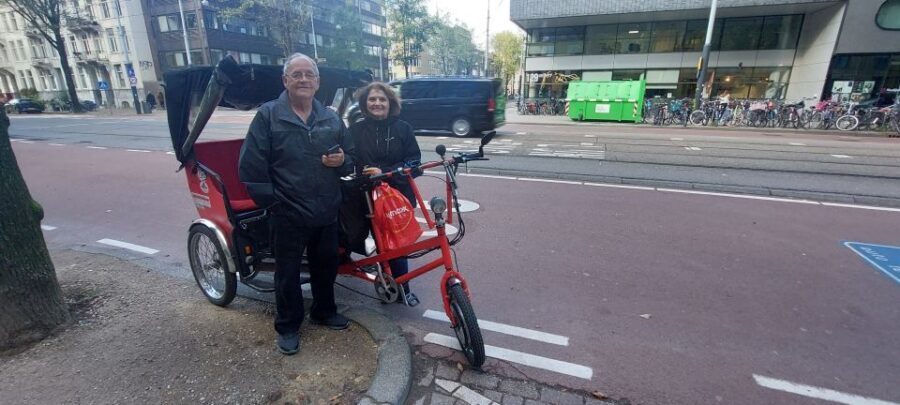
At $118 per group up to 2, this tour is priced like a true private experience rather than a mass-transport sightseeing bus. That’s important: you’re not just paying for transportation. You’re paying for:
- a guided route through multiple major areas,
- hotel pickup and drop-off,
- and the ability to cover distance with less walking.
For two people, the per-person cost can feel reasonable when you compare it to the cost of doing separate taxis plus entry tickets plus the time you lose trying to link everything efficiently.
This is also one of those tours that tends to make sense when you have limited time. If you only have a day or two in Amsterdam, this helps you get the “big picture” quickly. If you have a longer stay, it still works because it gives you a starting map for self-guided wandering.
The main “value check” is your travel style:
- If you love walking for hours, you might prefer spending the day on foot.
- If you want structure and comfort, a private rickshaw highlights tour is often a strong choice.
Guide Quality and the Little Details That Matter
The guide is part of the product here. You’ll have live guiding, and the languages offered are Bulgarian, English, and Greek. That’s helpful if you want real explanations rather than guessing.
In practice, what stands out is communication and tone. One guide named Bobby is described as both friendly and informative, and another guide named Lampros is noted for delivering a smooth two-hour experience where the route covered plenty of ground. I like that the tour experience isn’t just “drive and point.” You get context, and you get a real person steering the story.
Also, having WiFi on board and a speaker means the ride can feel more comfortable if you’re catching up on messages or want audio support while you travel.
One operational detail to keep in mind: start times can cause confusion if you don’t confirm clearly. It’s smart to double-check the timing with your guide and stay ready for the pickup window.
Who This Tour Is Best For
This is a good match if you:
- want an efficient highlights intro without walking nonstop,
- like having a guide explain what you’re seeing,
- travel as a couple (since it’s priced per group up to 2),
- need an easier way to cover distance due to mobility limits.
It may not fit if you:
- need wheelchair access (it’s not suitable for wheelchair users),
- rely on large bags or luggage during city sightseeing,
- travel with pets (assistance dogs aside).
Should You Book This Private Amsterdam Highlights Rickshaw Tour
I’d book it if your top goal is to get your bearings fast, see the headline neighborhoods, and leave with a clear mental map for the rest of your trip. The mix of Dam Square, the Red-Light District area, Nieuwmarkt, Museumplein, and Jordaan gives you both iconic Amsterdam and lived-in city texture.
Skip it (or change your plan) if your day is already mostly “museum time” and you don’t care about neighborhood orientation. Also, if your group doesn’t meet the rickshaw limits or you need wheelchair access, you’ll want a different option.
FAQ
How long is the Amsterdam private city highlights rickshaw tour?
You can choose a 1-hour or a 2-hour private guided tour.
What does the tour cost?
It costs $118 per group, up to 2 people.
Where does the tour start and end?
The tour includes pickup and drop-off in Amsterdam-Centrum.
What are the main highlights you’ll see on the route?
You’ll pass by and get guidance around Dam Square, the Red-Light District, Chinatown, Nieuwmarkt, Rembrandtplein, Magere Brug, Museumplein, De Negen Straatjes (9 Small Streets), and the Jordaan. The longer option also includes extra sights.
What extra sights are included if I book the 2-hour tour?
The 2-hour option adds Vondelpark, De Gooyer Windmill, and Rembrandt House.
Does the rickshaw include WiFi?
Yes, WiFi is available on board.
What languages do the guides speak?
Guides are listed as Bulgarian, English, and Greek.
Is this tour wheelchair accessible?
No, it’s not suitable for wheelchair users.
Are luggage or pets allowed?
Luggage or large bags aren’t allowed, and pets aren’t allowed (assistance dogs are allowed).
What is the weight limit per rickshaw?
The maximum weight per rickshaw is 500 pounds (230 kilograms), which can include up to 2 adults and 2 small children under 9.