REVIEW · ROTTERDAM
Rotterdam Must Do Tour: Highlights, History, WW2 and Architecture
Book on Viator →Operated by Trigger Tours · Bookable on Viator
Rotterdam’s comeback story hits hard on foot. This 2-hour walking tour is built around the city’s architecture after WWII, with stops that range from the famous Cube Houses to the futuristic Markthal. Two things I really like: the small group size (max 15) keeps it personal, and the guide-led pacing makes the history feel practical instead of textbook.
The main consideration is time pressure. Some stops are quick (often around 10–30 minutes), so if you want to linger for photos or shopping, you’ll have to plan extra time before or after the tour.
In This Review
- Key tour highlights (what makes it worth your time)
- Why Rotterdam’s rebuild story works best on a 2-hour walk
- Meeting at Stationsplein, then getting your bearings the right way
- Rotterdam Centraal and the architecture lens for first-timers
- Groot Handelsgebouw (1953) and the WWII-to-mid-century bridge
- The shopping streets: West-Kruiskade and Lijnbaan after destruction
- Luchtsingel: the wooden bridge that returns a forgotten area
- Nieuwe Delftse Poort and Sint-Laurenskerk: old Rotterdam, rebuilt in different ways
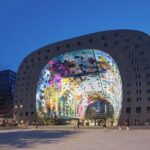
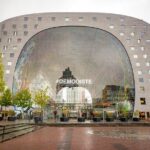
- Markthal by MVRDV: where Rotterdam turns food and art into architecture
- Oude Haven and the Cube Houses: Rotterdam’s most photogenic corner
- Price and what you really get for $29.41
- Who should book this tour (and who might want a different plan)
- Should you book the Rotterdam Must Do Tour?
- FAQ
- Is the tour offered in English?
- How long is the walking tour?
- How much does the tour cost?
- Where is the meeting point?
- Does the tour include admission tickets?
- Is food or drinks included?
- What sights do we see?
- How many people are in a group?
- Do I get a mobile ticket?
- Can I choose different tour times?
Key tour highlights (what makes it worth your time)
- Small group of up to 15 keeps questions easy and the route feel focused
- WW2 reconstruction theme links the landmarks so you understand why they look the way they do
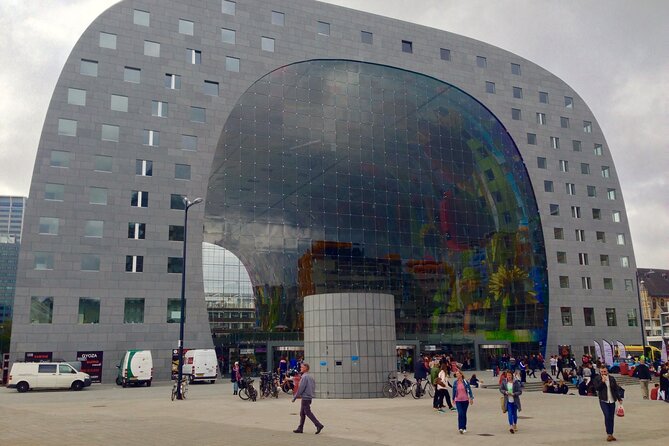
- Markthal by MVRDV: the horseshoe-style building plus the big interior food-and-seed artwork
- Luchtsingel bridge (390 meters): a long wooden walkway that connects a neglected area back into city life
- 1953 landmarks like Lijnbaan and Groot Handelsgebouw help you trace the mid-century rebuild
- Free entry spots along the route, from Sint-Laurenskerk (inside free) to major sights
Why Rotterdam’s rebuild story works best on a 2-hour walk
Rotterdam is one of those cities where the skyline is basically a conversation. You can see it in the way the city rebuilt after the bombing—less denial, more decision. On this tour, you get that story without needing museum time or a car.
The route is tight on purpose. In just about two hours you’ll hit the places that explain Rotterdam’s shift: from harbor-centered industry to modern design, from damaged streets to new pedestrian shopping zones, and from old gates to steel reconstructions. It’s a fast overview, but it’s also coherent—each stop answers the question, Why does this exist?
I also like how the guide approach tends to be story-first. You’re not just looking at buildings; you’re learning what people wanted after the destruction, and what they were willing to try. Some guides you might get are names like Susan, Michel, Edwin, and Stephan, and the common thread is that they’re clearly proud of Rotterdam’s design choices.
You can also read our reviews of more historical tours in Rotterdam

Meeting at Stationsplein, then getting your bearings the right way
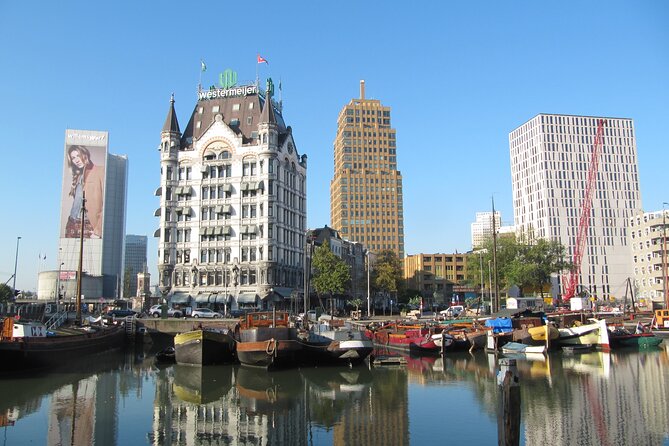
You start at Stationsplein 10 in central Rotterdam, and you’ll meet the guide there before heading out. This location is helpful because it’s tied to Rotterdam’s transit network, so it’s easy to reach even if you’re coming from outside the city center.
From there, you move toward Rotterdam Centraal Station, where the guide sets the architecture context. This matters because Rotterdam can feel like a mash-up—modern towers, sharp angles, and mid-century blocks. Getting a quick framework early helps you “read” the city as you go, instead of treating each landmark like a random stop.
Also, the walking format helps you notice details that you’d miss if you only drove past. You’ll be close enough to spot materials, street layouts, and how people actually move through these areas.
Rotterdam Centraal and the architecture lens for first-timers
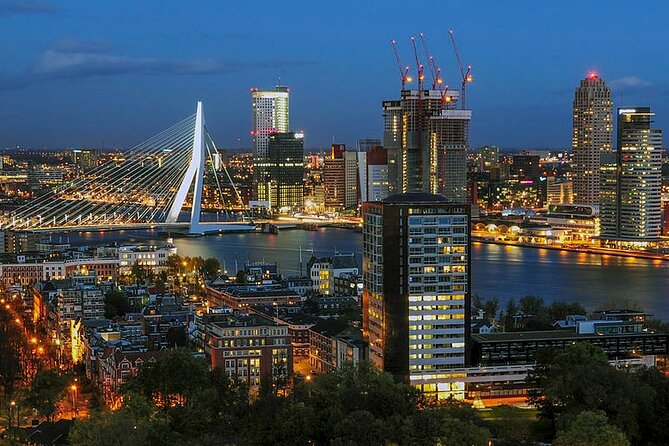
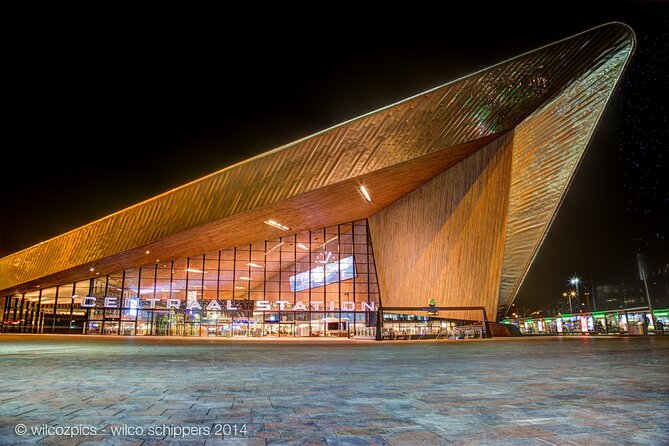
At Rotterdam Centraal Station, the guide focuses on the city’s architectural logic. You get short, high-value orientation—enough to connect what you’ll see later with the broader story.
What to expect here: you’ll likely spend about half an hour at the station stop. That’s long enough for a guided introduction and quick questions, but short enough that the tour keeps flowing toward the city’s more iconic design.
If you’re the type who loves history but also likes hands-on context, this part works well. You’re not just hearing dates—you’re building a mental map of why Rotterdam looks modern in the way it does.
Groot Handelsgebouw (1953) and the WWII-to-mid-century bridge
One of the most interesting turns in the walk is the stop at Groot Handelsgebouw, completed in 1953. The key point is simple: it’s described as one of the first major buildings built after the bombing of Rotterdam.
This stop is a reminder that reconstruction didn’t just mean rebuilding what was there. It also meant new priorities, new styles, and new confidence. The guide’s framing here tends to make the rebuilding feel less abstract.
Time at this point is brief (about 10 minutes), but that’s enough to plant the idea: mid-century Rotterdam wasn’t slow and cautious—it was moving. If you want to take photos, do it quickly and move on; the tour is designed around momentum.
The shopping streets: West-Kruiskade and Lijnbaan after destruction
Next, you head into the center shopping corridors: West-Kruiskade and then Lijnbaan, Rotterdam’s main pedestrian shopping street. The guide focuses on how these streets were rebuilt and reimagined after the old shopping district was destroyed during the bombing.
Lijnbaan opened in 1953 as the main pedestrian street in the new shopping district. That date matters because it connects directly to the mid-century reconstruction theme you started hearing earlier. In other words, this isn’t only a shopping detour—it’s part of the city’s design recovery plan.
Practical tip: if you’re not a shopper, you may feel some segments are less exciting. Still, even non-shoppers can appreciate street planning and pedestrian design here. You’re basically watching the city decide to prioritize walkability and retail space in its rebuilding era.

Luchtsingel: the wooden bridge that returns a forgotten area
Then comes Luchtsingel, a wooden pedestrian bridge about 390 meters long. It connects Rotterdam North with Rotterdam Center and is described as a way to bring life back to an area that had been abandoned for years.
This is one of the more emotionally satisfying stops on the route because it’s not just about iconic buildings. It’s about repurposing and reconnecting parts of a city. You’ll walk past the sense of renewal: the city stitching neighborhoods back together with a simple, human-scale design.
Time is short (around 10 minutes), but you’ll still get the main idea. If you like urban design that improves daily life—paths, crossings, and connections—this is the stop you’ll remember.
Nieuwe Delftse Poort and Sint-Laurenskerk: old Rotterdam, rebuilt in different ways
Two stops bring you face-to-face with Rotterdam’s older layers.
First is Nieuwe Delftse Poort (also described as a reconstruction on the site of the old Delft gate). The original gate was last built in 1764, and later a reconstruction in steel was erected, designed by artist Cor Kraat, on virtually the original site on Pompenburg. This is a great example of Rotterdam’s approach: keep the idea of the past, but use materials and design that fit the present.
Then you reach Grote of Sint-Laurenskerk, the Protestant church. The important detail here is that it’s the only remnant of the medieval city of Rotterdam. You can also go inside for free, and the tour gives you time to do it (about 10 minutes).
If you want one stop on this tour that feels quietly meaningful, make it this church. It’s the kind of place where you understand that not everything could be rebuilt in the same way—and that preservation became a priority too.
Markthal by MVRDV: where Rotterdam turns food and art into architecture
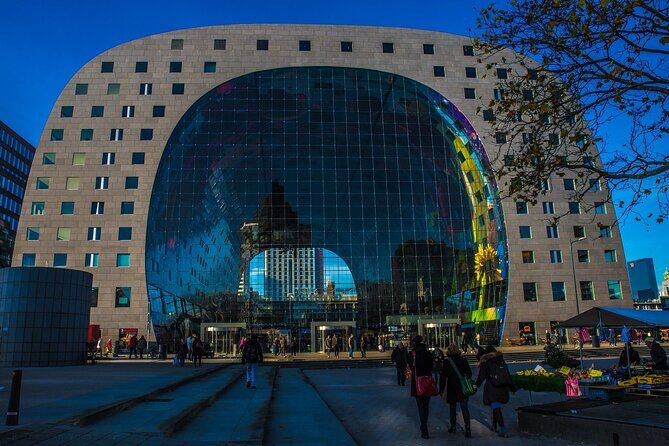
The tour’s design moment for many people is Markthal. You’ll spend about 30 minutes here, which is generous compared to some other stops.
Here’s what makes it special and different:
- It’s designed by the architectural firm MVRDV.
- The building has a horseshoe-like arch structure.
- The exterior is described as grey nature stone.
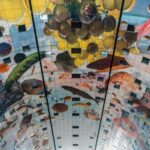
- Inside, you’ll find lots of restaurants and a major artwork showing strongly enlarged fruits, vegetables, seeds, fish, flowers, and insects.
That interior artwork detail is the kind of thing that changes how you feel about the market. You’re not just visiting a place to eat or browse; you’re standing in an architectural canvas. Even if you don’t plan to buy food, it’s worth seeing how the building frames the experience.
One watch-out: because the tour is walking-focused, you’ll have enough time to see what matters, but you won’t have unlimited browsing time. If you care most about photos and lingering, plan to come back after the tour.
Oude Haven and the Cube Houses: Rotterdam’s most photogenic corner
Finally, you head to Oude Haven (the Old Harbour), described as a historical hotspot in Rotterdam’s city center north of the Maas river. This area is known for atmosphere and for connecting the city’s past harbor identity with modern life.
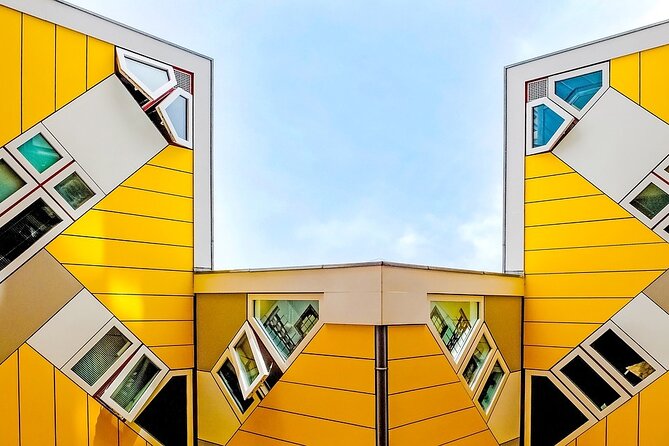
It’s also where you’ll find the famous Cube Houses. The Cube Houses fit perfectly into the tour theme: they’re recognizable, playful, and unmistakably Rotterdam—design that refuses to be boring.
You’ll spend about 20 minutes around this area, which is enough to see the major viewpoints and take in the mix of waterfront setting plus architecture. If you want the best photos, don’t treat this like a quick pass-through. Move to a couple of angles, get one wide shot, then one close-up, and you’ll capture the shapes properly.
Price and what you really get for $29.41
At $29.41 per person for roughly 2 hours, this tour is priced like a budget-friendly way to get real structure to your day. The value isn’t just the price tag—it’s the combination of:
- a local guide
- a tight route with major landmarks
- admission tickets listed as free for the stops on the way
- small group size with a max of 15 travelers
- and an English-speaking guide
So you’re paying for interpretation, not entrance fees. That’s the right kind of investment in a city like Rotterdam, where design language and reconstruction decisions matter. If you go on your own, you can absolutely research, but you’ll miss the “why this looks like that” explanations that make it click.
One more plus: the tour has different start times, so you’re more likely to fit it around other Rotterdam plans.
Who should book this tour (and who might want a different plan)
This tour is a strong match if you:
- are short on time and want a connected overview
- care about architecture and city planning
- want a straightforward answer to how Rotterdam rebuilt after WWII
- like walking routes with stops that are easy to find again later
It may feel less ideal if you:
- prefer long stops and slow wandering (this one is paced)
- mainly want museum-style history instead of architecture-driven context
- expect lots of shopping time (some shopping streets are part of the route, but you’re not there to browse for an hour)
Also, if you’ve never done a walking architecture tour before, this is one of the safer bets because the guide-led focus helps you stay oriented even when the city looks unfamiliar.
Should you book the Rotterdam Must Do Tour?
Yes, I’d book it if you want a practical, high-signal introduction to Rotterdam. The tour’s real strength is that it ties together WW2 reconstruction, mid-century rebuilding, and modern design into one walk you can actually remember.
I’d pay extra attention to pacing if you’re the type who wants deep time in one place—Markthal especially, and the Cube Houses area. If that’s you, do this tour early, then return on your own for the stop that grabbed you most.
FAQ
Is the tour offered in English?
Yes. The tour is offered in English.
How long is the walking tour?
It’s listed as 2 hours (approx.).
How much does the tour cost?
The price is $29.41 per person.
Where is the meeting point?
You meet at Stationsplein 10, 3013 AJ Rotterdam, Netherlands.
Does the tour include admission tickets?
Admission tickets are listed as free for the stops on the route.
Is food or drinks included?
No. Food and drinks are not included.
What sights do we see?
You’ll visit major landmarks such as the Cube Houses, Markthal, Rotterdam Centraal Station, Groot Handelsgebouw, Luchtsingel, Nieuwe Delftse Poort, Sint-Laurenskerk, Oude Haven, and the shopping streets including Lijnbaan and West-Kruiskade.
How many people are in a group?
The tour has a maximum of 15 travelers.
Do I get a mobile ticket?
Yes. The tour includes a mobile ticket.
Can I choose different tour times?
Yes, the tour offers different tour times to fit your schedule.