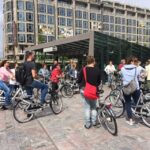
Rotterdam on a pedicab feels like cheating. You get a private guide plus a customizable route so you can cover big landmarks in a short window without dragging a group on foot. It’s also built for real life: hotel or cruise port pickup means you lose less time figuring things out and more time looking around.
I particularly love how the ride turns Rotterdam’s story into something you can see. From the rebuilt city center to the modern food-and-shopping hub of Markthal, your guide (people like Izzy, Ali, Boy, Mo, and Said) explains what you’re looking at in plain language, with fun context and smart timing. My second favorite part: the pacing is easy. You sit, you pedal slowly, and you can actually ask questions without getting winded.
One drawback to plan for: this is an orientation-style tour. Each stop is short (think 10 to 30 minutes), so if you want long museum time or deep browsing, you’ll need to pair it with a longer self-guided visit later.
In This Review
- Key Things to Know Before You Go
- Why a Private Pedicab/Rickshaw Tour Is a Smart Rotterdam Move
- Price and Timing: Getting Value in 1 to 1.5 Hours
- Pickup and That First Rolling Look at Rotterdam
- Stop 1: Rotterdam Centraal Station and the Postwar Transportation Fix
- Stop 2: Nieuwe Delftse Poort and the City Gate That Had to Move
- Stop 3: Rotterdam City Hall (and the WWII Survival Details)
- Stop 4: The Meent Area and Rotterdam’s People-First City Ideas
- Stop 5: Grote of Sint-Laurenskerk, the Medieval Anchor
- Stop 6: Markthal and the Rotterdam Food Hall Experience
- Stop 7: Kijk-Kubus Museum-House (Cube Houses) and the Human-Scale Design Idea
- What Guides Actually Do That Makes the Tour Worth It
- Who This Tour Fits Best (and Who Might Want a Different Option)
- Should You Book This Private Pedicab/Rickshaw Tour of Rotterdam?
- FAQ
- How long is the private pedicab/rickshaw tour?
- Is this tour private?
- How many people can ride together?
- Is pickup included?
- Are tickets included for the churches and museum-house stops?
- What’s included besides the guide and transportation?
- What languages is the tour offered in?
- Can service animals join the tour?
- Can I cancel for a full refund?
- Is there a weight limit?
Key Things to Know Before You Go
- Door-to-door pickup from hotels in central Rotterdam and major cruise docks
- Private, up to 2 people so you can set the pace and tailor what matters
- Comfort + efficiency: pedicab/rickshaw access makes it easy to cover more on bike-friendly routes
- Architecture meets history: WWII scars and post-war design ideas explained clearly
- Ticket support at select stops (included for Laurenskerk and the Cube House museum)
Why a Private Pedicab/Rickshaw Tour Is a Smart Rotterdam Move
Rotterdam is not a city where you have to “walk everywhere.” It’s a city where you can move. The pedicab/rickshaw setup fits that vibe perfectly. You glide between key areas while your guide handles the route and the storytelling.
You’ll also appreciate the privacy. This is only for your group, up to two people. That matters because Rotterdam’s highlights aren’t just “pretty buildings.” They’re tied to rebuilding, design choices, and what people decided to keep after the May 14, 1940 bombardment.
And you don’t have to be a sightseeing machine. If you’re traveling with a parent, a teen, or anyone who wants a lighter day, the ride keeps things manageable. One review experience noted that it was a great way for a short layover or limited time stay to get the gist of Rotterdam fast, and that’s exactly how I’d frame it.
You can also read our reviews of more guided tours in Rotterdam
Price and Timing: Getting Value in 1 to 1.5 Hours
The price is listed at $150.18 per group (up to 2), with an approximate duration of 1 to 1.5 hours. For two people, the math tends to work out well because you’re essentially paying for a private local guide plus private transportation rather than splitting a standard group tour cost.
If you’re traveling solo, it may feel less like a bargain and more like “buying convenience.” But the convenience is real: pickup, a private guide, and a vehicle that can stop often without turning your day into a logistics puzzle.
Booking is also typically done well ahead (often around two months). Rotterdam is popular, and private experiences get snapped up. If your trip dates are fixed, don’t wait until the week of.
Pickup and That First Rolling Look at Rotterdam
This tour starts with traveler pickup and drop-off. You can usually make it painless by requesting pickup at your hotel in or around the center. If you’re arriving on a cruise, pickup is offered at the main docking areas: Rotterdam Cruise Terminal for most sea cruises, and Boompjeskade for many river cruises.
You’ll get a mobile ticket, and your guide will meet you with a plan. Then you’re off.
That “first rolling look” is underrated. Rotterdam’s neighborhoods and design language can feel confusing at ground level. From the pedicab seat, everything lines up faster: where the big civic buildings sit, how the modern structures relate to the older street patterns, and where the city changed direction after the war.
Stop 1: Rotterdam Centraal Station and the Postwar Transportation Fix
Your first stop centers on Rotterdam Centraal Station, which is one of those landmarks that tells you a lot just by existing.
Before the Second World War, Rotterdam didn’t have a single central station. It was split across four stations around the core. In 1957, the central station opened at its current location. Then in the 2000s, a major renovation began, with the finished result delivered in 2014. The key point your guide will hit: the old setup could no longer handle passenger demand.
Why this matters for you: even if you don’t take trains, the station tells the story of Rotterdam’s growth and how the city keeps rebuilding its flow. It’s also a helpful starting point because it anchors your bearings fast.
Time here is about 10 minutes, and it’s intentionally short. Think of it as orientation while your legs warm up and your guide starts the big-picture timeline.
Stop 2: Nieuwe Delftse Poort and the City Gate That Had to Move
From the station area, you’ll head to Nieuwe Delftse Poort, a former city gate with a surprisingly dramatic life.
Back in the Middle Ages, Rotterdam had 10 city gates. In the 1930s, the city grew quickly and the gate got in the way. Officials decided to move it about 100 meters so traffic could flow better. Moving a gate was no small thing, and there was strong resistance.
Then came the war. During the bombing in WWII, the gate was severely damaged. A year after the bombing, it was demolished because it couldn’t be finished. Some decorative elements were saved and later incorporated into buildings around the town hall square.
What you’ll like: you’ll stop expecting “a gate” and instead see layers of decisions—urban planning, conflict, and reuse of details after destruction. That’s very Rotterdam: practical, determined, and unwilling to waste what can be salvaged.
You can also read our reviews of more private tours in Rotterdam
Stop 3: Rotterdam City Hall (and the WWII Survival Details)
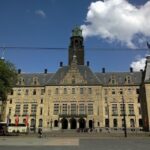
Next up is City Hall Rotterdam, built between 1914 and 1920 by Henri Evers. It’s known for surviving the May 14, 1940 bombardment, which makes it one of the few center-area buildings still standing from that era.
This stop is about 10 minutes, and it’s a great moment for your guide to point out what’s visible now and what the building represents. One guide-led moment you might get is a focus on WWII impact markers, like bullet-hole details that some guides bring into the story.
Practical tip: if you’re photographing, this is a good place to slow down for a few shots. Your pedicab time is precious, and the architecture here gives you strong angles.
Stop 4: The Meent Area and Rotterdam’s People-First City Ideas
The route then shifts toward the Meent, one of the city’s hotspots. It’s packed with cafés, eateries, and clothing shops—today’s “life on the street” energy.
This area also has an arc. In the 1990s, the Meent had a more temporary-employment and travel-agency feel, and it was described as atmosphereless with more vacancies. Then it changed.
A name you may hear is Robin von Weiler, who is associated with the Meent nickname Mr. Meent due to the impact of his efforts on the street.
This is also where a broader city-initiative idea fits in. In 2011, the municipality launched an initiative meant to stimulate administrative innovation and citizen participation. Residents could submit projects meant to enliven the city and improve quality of life, with €4 million set aside for implementing the results.
Why include this in a short tour: because Rotterdam isn’t just a war-rebuild story. It’s also a “what do we do with public space now?” story. The Meent is a living example of how neighborhoods evolve from policy and people—not just architecture.
Stop 5: Grote of Sint-Laurenskerk, the Medieval Anchor
If you want the most historical “anchor” you’ll see on this route, it’s Grote of Sint-Laurenskerk.
This church is the only remnant of the medieval center of Rotterdam. Construction stretches from 1449 to 1525. Your guide will likely highlight the architectural blend: it’s a cross between a hall church (where building parts are more equal in height) and a cruciform basilica (with a floor plan shaped like a cross, and side towers lower than the main tower).
This stop is around 10 minutes, and admission is included. That’s a big plus because it removes friction. You’re not juggling ticket purchases while trying to keep up with a tight schedule.
What to expect practically: even in a short visit, you’ll likely get enough to understand why this mattered. It’s not the biggest building in the city, but it carries weight because it survived long enough to remain.
Stop 6: Markthal and the Rotterdam Food Hall Experience
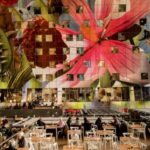
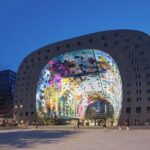
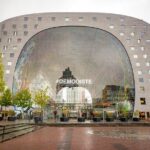
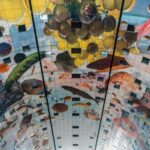
Next comes Markthal, a modern complex that combines a covered market with restaurants beneath an arch of apartments. It’s one of the most recognizable ways Rotterdam shows “modern city living” in a compact space.
This stop is about 30 minutes, and admission is free. For you, that means a relaxed pace in the middle of the tour, with time to look, snack if you want, and soak in how the city mixes food, daily errands, and design.
This is also a strong stop if you’re food-curious. Even if you don’t plan to eat a full meal there, you’ll get a sense of what locals gravitate toward and what the market vibe feels like.
One practical note: bring your camera or phone, because the interior architecture tends to look better once you’re inside the covered space. It also works for rainy days when you want shelter without stopping the tour entirely.
Stop 7: Kijk-Kubus Museum-House (Cube Houses) and the Human-Scale Design Idea
The last major visual payoff is Kijk-Kubus Museum-house, the famous Cube Houses area.
Here’s the story your guide will connect: in the 1970s, architects wanted residential neighborhoods that felt more hospitable and human-scaled, with participation from residents and other users. This response came after the large-scale, gray reconstruction architecture from WWII.
The architect associated with the concept is Piet Blom. He was a structuralist and a student/colleague mindset associated with Aldo van Eyck. The basic design idea is that the buildings are built on columns, leaving space underneath that stays public. The inspiration is often linked to Le Corbusier, especially the idea of shaping urban space rather than only adding buildings.
This stop is about 15 minutes, with admission included. That short, paid-in portion is one of the better “value locks” in the itinerary: you’re not just looking from outside. You’re getting enough interior or guided context to understand why the cubes exist in the first place.
If you’re into architecture, this is the moment you’ll feel Rotterdam’s identity most clearly: design that’s playful but still rooted in real planning choices.
What Guides Actually Do That Makes the Tour Worth It
A big reason this tour earns such strong marks is the guidance style. Several guides in the mix—Izzy, Ali, Boy, and Said show up in different experiences—and they share a consistent approach:
- They explain the why behind the what, especially with WWII survival and rebuilding.
- They point out photo moments and take time for pictures without making you feel rushed.
- They can adapt the timing to help you catch major sights within your available hours.
- They often ask if you have special requests before you start, then shape the route around that.
Even if you don’t have a “plan,” you can walk in and leave with clarity: where the landmarks sit, what the city rebuilt, and how modern Rotterdam organizes daily life.
Who This Tour Fits Best (and Who Might Want a Different Option)
You’ll likely love this if:
- you have limited time in Rotterdam (one day, a layover, or a short cruise window)
- you want a high-quality overview with a local guide
- you’re interested in architecture, WWII stories, and modern urban design
- you’d rather sit back and roll on bike-friendly routes instead of walking nonstop
You might consider a different plan if:
- you want deep museum time or a long sit-down lunch as part of your “main event”
- you’re the type who hates short stops and prefers long, lingering visits
- you’re expecting a long ride between far-flung neighborhoods (this tour focuses on a tight set of core sights)
Should You Book This Private Pedicab/Rickshaw Tour of Rotterdam?
Yes, if you want a fast, friendly way to understand Rotterdam without burning your day on logistics. The value is strongest for a small group (up to 2) because you’re paying for private transportation, a local guide, and pickup that reduces friction.
I’d book it especially if your time is tight or you’re arriving by cruise and need a smart first look. The itinerary hits the big storytelling beats: transportation and rebuilding at Centraal, survival and remnants at city landmarks, city-life evolution in the Meent, then modern Rotterdam through Markthal and the Cube Houses.
If you’re already planning to spend hours inside museums and shops, treat this as your orientation layer. It will help you choose what to revisit on your own.
FAQ
How long is the private pedicab/rickshaw tour?
It runs about 1 hour to 1 hour 30 minutes, depending on the flow of the route and time for stops.
Is this tour private?
Yes. It’s private, and only your group participates.
How many people can ride together?
The price is per group for up to 2 people.
Is pickup included?
Yes. Hotel pickup and drop-off are offered, and pickup is also available at common cruise docking locations.
Are tickets included for the churches and museum-house stops?
Admission is included for Grote of Sint-Laurenskerk and Kijk-Kubus Museum-house. Other listed stops are free admission.
What’s included besides the guide and transportation?
The tour includes bottled water, snacks, private transportation, and the rickshaw/pedicab itself.
What languages is the tour offered in?
The tour is offered in English.
Can service animals join the tour?
Yes, service animals are allowed.
Can I cancel for a full refund?
You can cancel up to 24 hours in advance for a full refund. If you cancel within 24 hours, the amount paid isn’t refunded.
Is there a weight limit?
Yes. For safety, the combined passengers weight must not exceed 200 kg/440 lbs.