REVIEW · THE HAGUE
Hague: The Heart of Old Town Exploration Game and Tour
Book on Viator →Operated by Questo · Bookable on Viator
A city game can feel oddly perfect. This self-guided walk turns key spots in The Hague into a clue-and-answer route, step-by-step on your phone. You’re not doing a lecture. You’re hunting for the next piece of the story, with offline play so you can keep moving without worrying about mobile data.
Two things I like a lot are how story-based the route feels and how it’s built for an easy schedule. You’ll bounce between iconic buildings (palaces, churches, museums, and government sites) and still keep it to about an hour. One catch: the experience depends on the app working smoothly and on you reaching each exact stop, so if a location is blocked or your phone navigation is off, the game can stall.
In This Review
- Key highlights at a glance
- How this clue walk helps The Hague click
- Starting at Lange Voorhout and ending at Spui: your walking plan
- Escher in Het Paleis: clues that make you look twice
- The Abbey Church in Loosduinen: old stones, a Roman-to-Gothic twist
- Noordeinde Palace: royal workplace energy, without the royal-tour vibe
- Great or St. James’ Church: baptisms, marriages, and that tall-tower feel
- Old City Hall near the Grote Kerk: civic ceremonies and royal registrations
- Gevangenpoort and the Prince William V Gallery area: prison history next to art
- The city-history museum stop: how to use a quick look for real context
- Mauritshuis: a “house turned museum” you can feel immediately
- Binnenhof: where the app makes government feel like a place
- Nieuwe Kerk (New Church): the Protestant highlight that closes the loop
- Price and phone-first logistics: is $7.20 good value?
- Who should book this Hague Old Town game
- Should you book this Hague Old Town exploration game?
- FAQ
- How long does this Hague Old Town game take?
- Is there a live guide with the activity?
- Do I need an internet connection to play?
- What language is the experience offered in?
- Where do I start and where do I end?
- Can I play it any time after booking?
- What if my group is larger than 15 people?
- What’s included in the price?
- Do I have to download anything or have a phone?
- Is free cancellation available?
Key highlights at a glance

- Offline-ready city game you can play without an internet connection
- Short time commitment at about 1 hour 5 minutes, great for a tight day
- A clue-based route that pushes you to look closely at landmarks
- Central Old Town coverage that helps you feel oriented fast
- No human guide contact, so you can avoid crowds while still seeing major sights
How this clue walk helps The Hague click

If you’ve ever felt that The Hague can be a bit “spread out,” this kind of game solves that problem. The route nudges you from place to place with small missions, so you don’t just wander—you progress. That makes the city feel more manageable, especially when you’re trying to fit it between museum time and dinner.
I also like that it’s history without the heaviness. Instead of a timeline dump, you’re looking around and picking up context by solving the next challenge. One review note specifically called out a background story tied to DeWitt, and that kind of character-driven thread is exactly what keeps the walk from becoming a checklist.
The main consideration is practical: this is phone-driven. If your app is hard to navigate, or you can’t reach a point cleanly, the game can end sooner than you want.
You can also read our reviews of more tours and experiences in The Hague



Starting at Lange Voorhout and ending at Spui: your walking plan
The walk is designed as a linear route. You start at Lange Voorhout 74 (near the start area around Den Haag), and you finish at Spui 175 by the end point. The whole thing runs about 1 hour 5 minutes on average, which is a sweet spot for jet lag days and “just one activity before dinner” days.
Also, the game is step-by-step in the Questo app. That matters because you don’t have to keep stopping to re-check your bearings. You follow the directions to get to the next location, then you look around to find the answer and move forward.
One small tip: wear shoes you’re happy walking in. The stops are spread across historic center streets, and you’ll likely do extra steps while you’re scanning facades and doorways for clues.
Escher in Het Paleis: clues that make you look twice
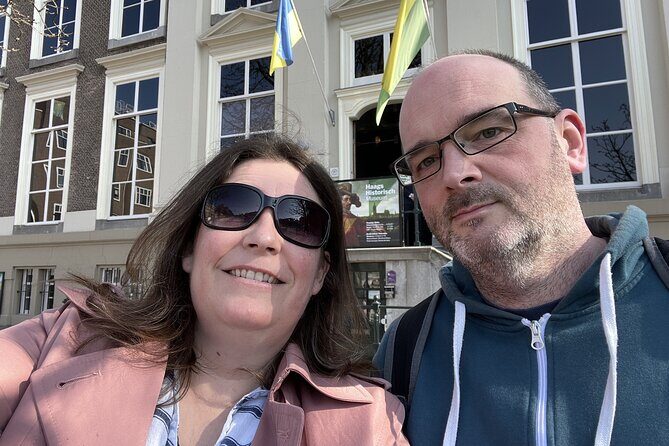
You begin at Escher in Het Paleis (Escher in the Palace) at Lange Voorhout. Even if you’re not deep into printmaking, the location is a strong opener because it’s tied to the famous Dutch graphic artist M. C. Escher and housed in the Lange Voorhout Palace area.
What the game does well here is force a slower pace at the start. Instead of rushing past a landmark, you’re given a challenge that pushes you to look for something specific before you move on. That sets the tone for the whole walk: this is a “look, read, notice” kind of experience.
Possible drawback: this is still a museum area, and while the game guides you through the exterior/nearby environment, you may find that access rules depend on current conditions and hours. If you plan to go inside anything, check that site’s own entry policies separately.
The Abbey Church in Loosduinen: old stones, a Roman-to-Gothic twist

Next comes the Abbey Church in Loosduinen, one of the oldest buildings in The Hague. The details are the fun part: it was built between 1238 and 1250 by the wife of Dutch Count Floris IV, and it reflects a transition style from Roman to Gothic.
In a normal tour, you might hear that and move on. In this game, you’re prompted to hunt for the clue, which makes the architecture feel more “alive.” You’re forced to pay attention to how older styles changed over time rather than treating the church as just another pretty stop.
One reason I think this works: religious sites often have layered history and reused meanings. When you slow down long enough to locate your answer, you start noticing the story embedded in the building’s details.
Noordeinde Palace: royal workplace energy, without the royal-tour vibe
Then you’re at Noordeinde Palace, one of the Dutch royal family’s three official palaces. This one is tied to modern rule: it has been used as the official workplace of King Willem-Alexander since 2013.
The game’s clue structure makes palaces more than postcard backdrops. Instead of “look at a palace,” you’re looking for the right information tied to where you are. That helps you connect past and present power in one short stretch.
Just manage expectations: you’re in a real royal-adjacent area. Your game experience is still about spotting answers in your immediate surroundings, and you may not be able to roam like a tourist in every corner. If you run into blocked areas, keep moving and let the app guide your next step.





Great or St. James’ Church: baptisms, marriages, and that tall-tower feel
The route continues to Great or St. James’ Church on Torenstraat—named for its high tower. It’s another “oldest in town” anchor: alongside the Binnenhof, it’s described as one of The Hague’s oldest buildings.
This stop is full of concrete royal references. The building has hosted baptisms and marriages for members of the House of Orange-Nassau, with the latest being Willem-Alexander and his daughter Catharina-Amalia, Princess of Orange.
Here’s what I’d watch for: when a site is connected to major life events, it tends to carry a different kind of atmosphere. The game’s mission-based format helps you slow down enough to notice that the church isn’t just historical. It’s part of how the country marks important moments.
Old City Hall near the Grote Kerk: civic ceremonies and royal registrations
Next you reach the Old City Hall on the Groenmarkt near the Grote Kerk. The building is Renaissance style and served as the former seat of the city government.
What makes it interesting in this format is its dual role: it still hosts civic wedding ceremonies, and it’s also where the Royal family registers family births. That blend—local life and national symbolism—often gets missed when you only focus on the big national monuments.
As you solve the clue here, you’ll probably find yourself scanning details you’d otherwise skip, like inscriptions and architectural cues around the building’s public face.
Gevangenpoort and the Prince William V Gallery area: prison history next to art
After the civic stop, you land at the Gevangenpoort, a medieval gate that also functioned as a prison. It’s on the Buitenhof and sits beside the Prince William V Gallery, an 18th-century art gallery founded by William V, Prince of Orange in 1774.
This is a great example of what the game does well: it mixes tone shifts without making you feel lost. You go from city life and government-adjacent spaces to a place that’s literally about confinement.
A practical note: older structures and fenced-off areas can affect how close you can get to specific “answer” spots. If you see barriers, don’t fight it. Keep your eyes open for the clue zone the app expects, or move in the directions it provides.
The city-history museum stop: how to use a quick look for real context
Mid-route, you’ll visit a museum detailing The Hague’s history, with artifacts, portraits, cityscapes, and temporary exhibitions. The game keeps it from turning into a long museum day by turning the visit into a brief clue moment.
Even if you don’t plan a deep museum session, this kind of stop is valuable because it gives you a framework. When you later see palaces, churches, and government buildings, you’ll understand how these places fit into the city story rather than treating them as separate tourist items.
One thing to consider: museums usually have their own hours and entry rules. The game doesn’t promise you access to every interior area, so if you want to spend time inside beyond the clue moment, check hours and consider tickets separately.
Mauritshuis: a “house turned museum” you can feel immediately
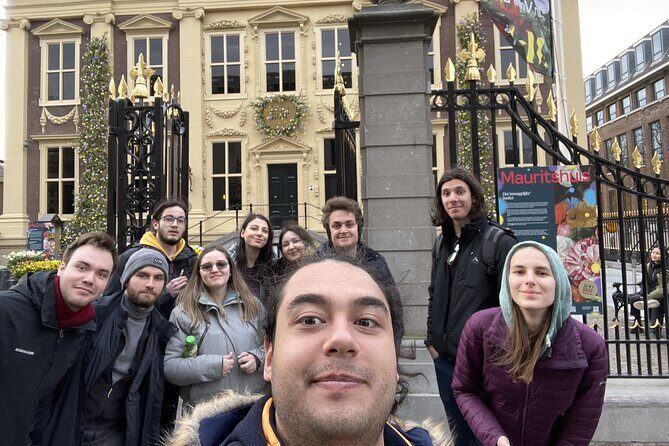
Then comes the Mauritshuis, one of the city’s best-known museums. The building matters as much as the collection: it was built in the 17th century as a private residence for Count Johan Maurits of Nassau-Siegen, which is why it’s sometimes tied to Maurits’s house. Since 1822, it has functioned as a museum.
The value here is how the game reframes the place. Instead of “walk through a museum,” you get prompted to connect the building to its origin. That makes the museum feel less like a ticketed stop and more like a piece of architecture with a past life.
If you’re an art fan, this is the point where you might start wishing you had time for more than the quick clue-based visit. But for the overall time budget, it’s a smart fit.
Binnenhof: where the app makes government feel like a place
Next up is the Binnenhof, a complex next to the Hofvijver in The Hague’s city center. It’s described as housing the meeting place of both houses of the States General of the Netherlands, plus the Ministry of General Affairs and the office of the Prime Minister.
This stop can be a little dry on a typical tour. Here, the game’s “find the answer” structure helps you treat it like an actual space where real decisions happen, not just a symbol.
What I like is that you end up noticing the urban layout. You’re not just reading about power; you’re walking through an area that makes that power feel visible in the surrounding buildings and streets.
Nieuwe Kerk (New Church): the Protestant highlight that closes the loop
Your finish is the New Church, known as the Nieuwe Kerk, built in 1656. The game frames it as one of the oldest monuments in the city centre of The Hague and a pinnacle of Protestant religious architecture in Holland.
There’s also a detail that makes the stop feel unusually specific: the church once stood on an island until surrounding canals were filled in around 1900. That kind of fact turns a church façade into a story about how the city physically changed.
Because this is the last challenge, it also works as a satisfying wrap-up. You’ve spent the hour looking at older architecture, civic rituals, royal spaces, and government centers. Finishing at a church tied to both architecture and city planning gives the walk a sense of resolution.
Price and phone-first logistics: is $7.20 good value?
At $7.20 per person for about 1 hour 5 minutes, you’re paying for a self-guided experience that combines route guidance with an offline story game. Compared to paying for a traditional guided walk, it’s a bargain, especially if you’re comfortable navigating with your phone.
You also get some practical advantages baked in:
- It’s private, with only your group participating.
- It’s described as no human contact, which can help you avoid crowd situations.
- It’s mobile-ticket based and designed to be played any time after booking without rescheduling.
The “value” question really comes down to you and your patience for apps. If you like puzzles and don’t mind reading prompts, the price is a strong deal. If you want something hands-on and human-led, this will feel like too much work.
Who should book this Hague Old Town game
I’d point you toward this experience if you want:
- A light, story-based way to see central highlights without getting stuck in lecture mode
- A route that fits a tight schedule
- An activity that’s easier to control day-to-day because you can play it on your own timing
- A safer choice if you’d rather avoid crowds, since it’s set up with no human contact
It may not be the best fit if you:
- Don’t like app-based navigation
- Need everything to be fully step-proof (the game depends on reaching each exact stop)
- Prefer audio stories, because reading in bright sunlight can be tough
A smart approach: bring a phone charger or power bank, keep brightness up, and give yourself a little extra time cushion if construction blocks a route.
Should you book this Hague Old Town exploration game?
If you’re the type who likes walking while solving small challenges, this is a solid buy. It’s inexpensive, it stays focused on central sites, and it uses the game format to make places like Escher in Het Paleis, Noordeinde Palace, the Binnenhof, and the Nieuwe Kerk feel connected.
If your ideal tour is a live guide answering questions on the spot, skip it. This is about self-paced discovery, guided by your phone, and it depends on you getting to the right spots.
FAQ
How long does this Hague Old Town game take?
It runs for about 1 hour 5 minutes (approx.).
Is there a live guide with the activity?
No. There is no physical tour guide. It’s a private, self-guided experience with no human contact.
Do I need an internet connection to play?
No. You can play offline, so you do not need internet to do the game.
What language is the experience offered in?
It’s offered in English.
Where do I start and where do I end?
You start at Lange Voorhout 74, 2514 EH Den Haag, Netherlands, and end at Spui 175, 2511 BM Den Haag, Netherlands.
Can I play it any time after booking?
Yes. You can play it anytime after booking without rescheduling.
What if my group is larger than 15 people?
If your group is larger than 15, you can book multiple bookings.
What’s included in the price?
You get the mobile ticket and step-by-step guidance through the app. The experience is also playable offline and is set up for a private group with no human contact.
Do I have to download anything or have a phone?
This is played through the Questo app, so you’ll need access to the app on your mobile device to follow the step-by-step instructions.
Is free cancellation available?
Yes. You can cancel for a full refund up to 24 hours in advance of the experience start time.