REVIEW · THE HAGUE
Private Walking Tour of Delft: Dive into the Dutch Golden Age
Book on Viator →Operated by Discover Delft · Bookable on Viator
Delft looks small, but it packs in stories. This private walking tour strings together the city’s most meaningful spots—from royal burial ground to Vermeer connections and the rules that kept the canals alive. You start right by the Hugo Grotius statue on Markt, then you follow a smart route that makes Delft feel like one connected place, not a checklist.
I especially like two things: the private format (so your guide can slow down, answer questions, and adapt to your group), and the Vermeer-to-history mapping, where the paintings connect to real locations and buildings. One drawback to consider: with a duration of about 2 hours, it’s not built for long inside visits—so come with shoes ready for walking and plans for any extra museums afterward.
In This Review
- Key highlights at a glance
- Hugo Grotius on Markt: how the tour sets you up fast
- New Church on Market Square: royal burials and a tower that dominates the skyline
- Stadhuis Delft and the Old Church’s leaning tower: civic power to art gravity
- Prinsenhof Delft and William of Orange: how one assassination reshaped a country
- Oude Delft canal and the Gemeenlandshuis van Delfland: why Dutch survival was organized
- Armamentarium and the Dutch East India Company: Golden Age ambition in stone
- Synagogue memory at Vrienden van de Synagoge Delft and a laid-back ending at Beestenmarkt
- Price and what you’re really paying for (private group up to 15)
- Timing, walking pace, and how to make the route feel easy
- Should you book this Private Walking Tour of Delft?
- FAQ
- How long is the private walking tour of Delft?
- What is the meeting point for the tour?
- Is the tour private or shared with other groups?
- How much does the tour cost?
- Is pickup available?
- What language is the tour offered in?
- Are there admission tickets you need to pay for stops?
- How does confirmation work after booking?
Key highlights at a glance
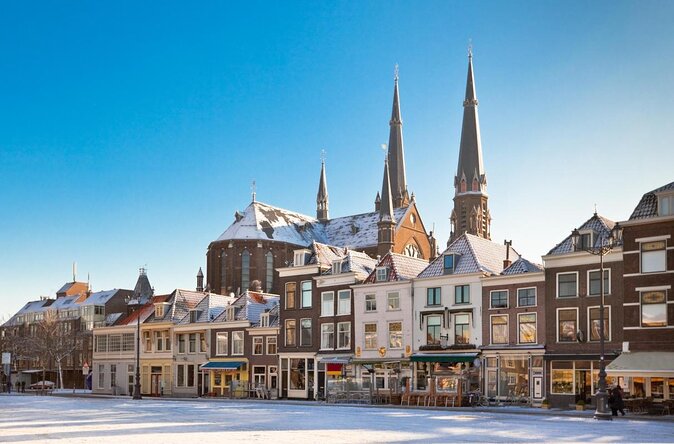
- Market Square start/finish by the Hugo Grotius statue (easy to find, easy to return)
- Golden Age landmarks in one route, from Stadhuis and the Old Church to the Dutch East India Company building
- New Church + Old Church contrast, royal burials vs. Vermeer’s grave and the leaning tower
- Orange family impact at Prinsenhof, including the assassination site of William of Orange
- Canals with purpose at Gemeenlandshuis van Delfland, including how water boards kept Delft alive
- A calm ending with food options at Beestenmarkt, where your guide can point you toward local beer and snacks
Hugo Grotius on Markt: how the tour sets you up fast
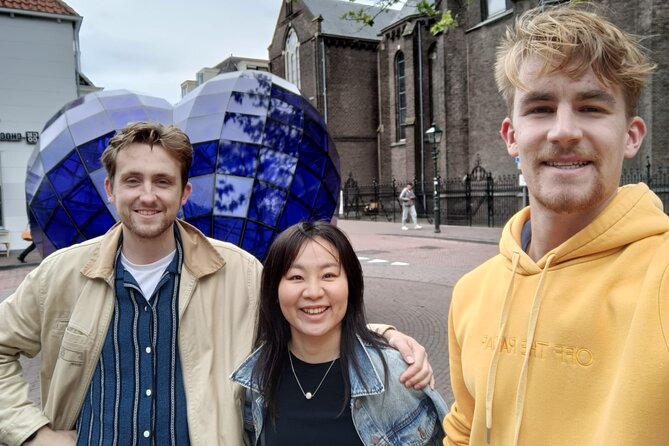
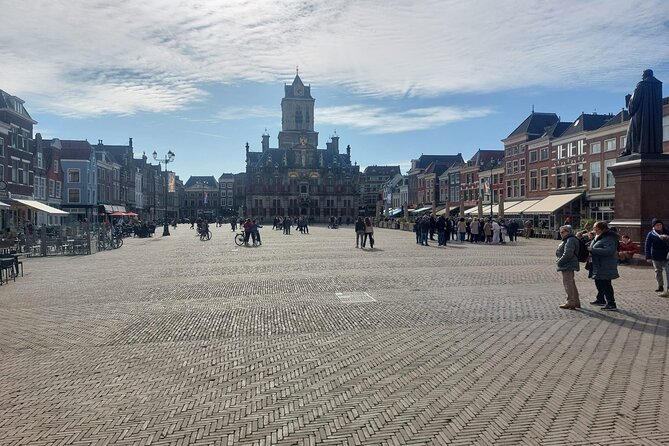
The tour begins at a spot that makes Delft click immediately. You meet at the Hugo Grotius statue on Markt, Delft’s central square, one of the oldest market squares in the Netherlands. This is also where the route loops back at the end, so you’re never hunting for your bearings.
Why I like this setup: Delft’s charm is partly about flow—canals, narrow streets, and sudden views of towers. Starting on Markt lets your guide orient you early, then you move outward in a way that keeps the city readable as you go.
If you want the tour to feel even smoother, there’s optional pickup from any place in the city centre. That can be handy if you’re arriving from The Hague on the day, or if your group includes someone who doesn’t want extra transfers.
You can also read our reviews of more tours and experiences in The Hague.


New Church on Market Square: royal burials and a tower that dominates the skyline
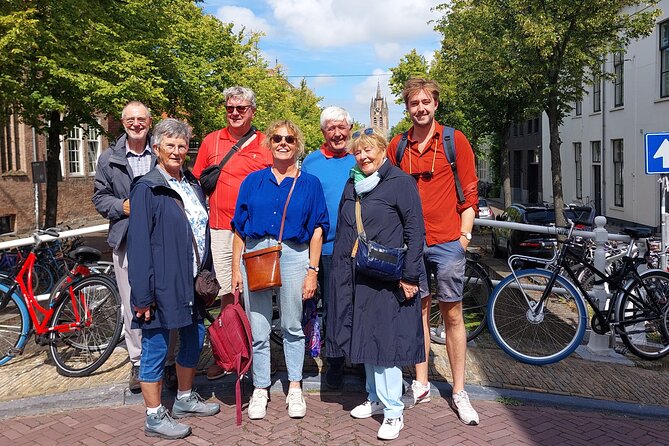
The first stop is the New Church beside Markt, the anchor point for the whole walk. Your guide welcomes you here and frames the New Church in the story of Delft and the Dutch Republic.
This church matters for two major reasons. First, it’s the burial place of the Dutch royal family—and also Hugo Grotius himself, a name you’ll keep hearing in Dutch history. Second, the New Church’s tower is the second tallest church tower in the country. Even if you don’t go up, you’ll see enough from street level to understand why towers like this were a kind of public marker: who had power, where communities gathered, and how the city wanted to be seen.
Since the admission here is free, you can spend your short time focusing on what your guide points out—context, symbolism, and why this building is so much more than a pretty façade.
Stadhuis Delft and the Old Church’s leaning tower: civic power to art gravity
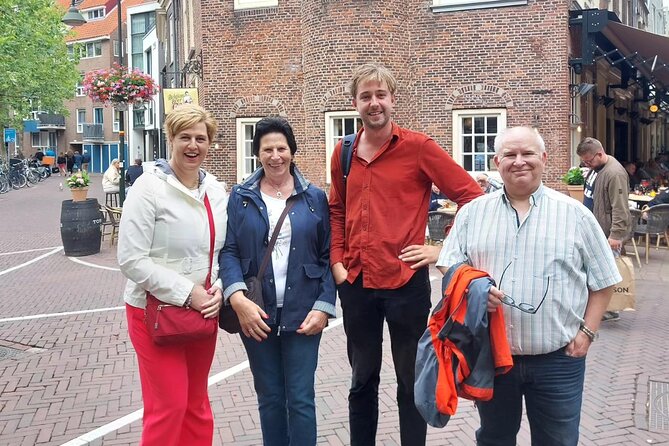
Leaving Markt, you pass the Stadhuis Delft, the city town hall. It’s one of Delft’s most significant civic buildings, and it’s a great example of how a single structure can contain layers of conflict. The Renaissance façade may look elegant, but behind it there’s a more turbulent history involving fires, justice, and city governance, including a time when it served as a former prison.
Then the walk pushes toward the Old Church, and this is where Delft’s identity gets personal. On the way, your guide points out several historic references: the former Butter House, the old Weigh House, and the historic home of Antonie van Leeuwenhoek. You’ll also move through the general area that once served as Delft’s former beer-brewing quarter. It’s not just “look at old buildings.” It’s learning how everyday trade and production supported the city’s rise.
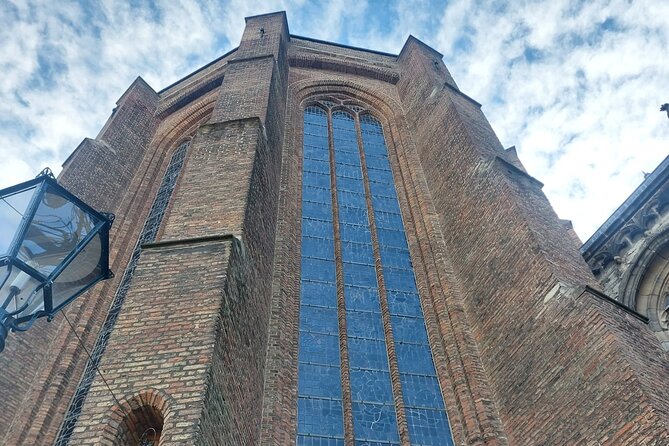
Inside the Old Church, the highlight is Johannes Vermeer. The grave of Vermeer is located here, and your guide explains why the Old Church’s tower began to lean almost as soon as construction started. That detail changes how you look at the building: it becomes a record of time and engineering rather than a static postcard.
All stops on this tour list admission as free, so you won’t be juggling tickets while trying to absorb the story.
Prinsenhof Delft and William of Orange: how one assassination reshaped a country
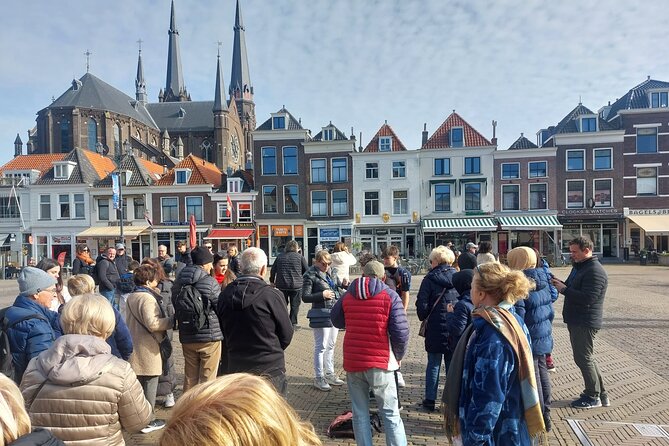
Opposite the Old Church sits Museum Prinsenhof Delft, and it’s one of the strongest stops on the route for pure historical weight. This was once a monastery, later becoming the residence of William of Orange, known as the Father of the Fatherland. The story turns sharply here: William of Orange was assassinated in 1584.
Your guide connects that event to why Delft became closely linked to the House of Orange. Even if you’ve heard the name before, it helps to place the moment in a physical setting. Standing there, you start to see how political change in the Dutch Republic wasn’t an abstract concept—it was tied to real walls, real decisions, and real danger.
The pacing also works. This stop gives you a historical climax without turning the whole walk into a museum day. You get the meaning, then you keep moving while your attention is still switched on.
Oude Delft canal and the Gemeenlandshuis van Delfland: why Dutch survival was organized
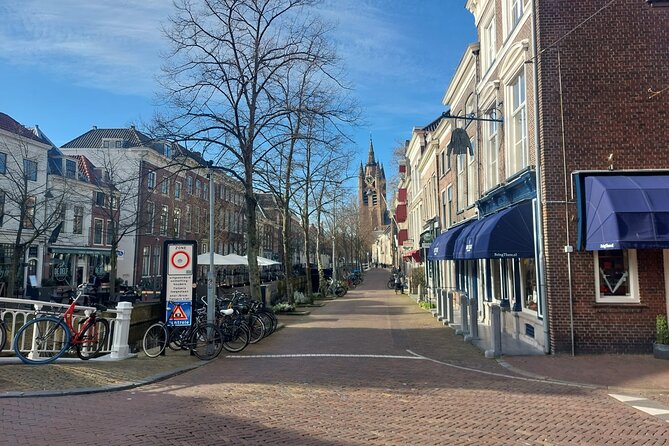
The walk shifts along the Oude Delft canal, and you get a different kind of Delft lesson at Gemeenlandshuis van Delfland. Here your guide points out the oldest surviving house in the city. Since 1645, this richly decorated building has housed the local Water Board.
This is the sort of stop that can be surprisingly moving, because it’s not about royalty or famous artists—it’s about how a city survives. Your guide explains what a water board is and why it was vital to Delft’s prosperity. In the Netherlands, water management has always been life-and-death work, and Delft’s story depends on it.
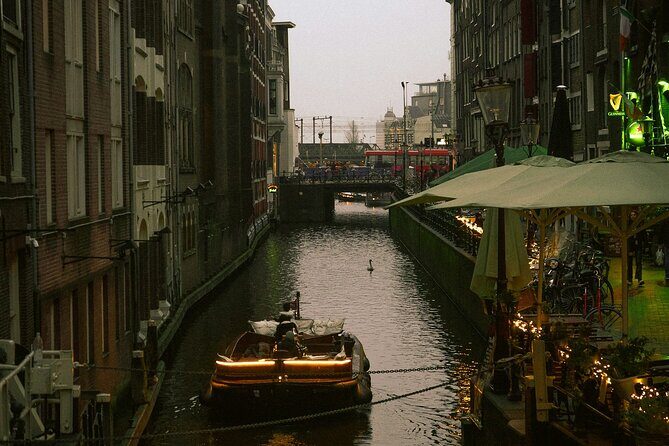
If you’re the type who likes your history practical, this stop hits. It turns “the canals are pretty” into “the canals are engineered.” You start noticing that Delft’s shape and survival are connected, even when you’re just walking beside the water.



Armamentarium and the Dutch East India Company: Golden Age ambition in stone
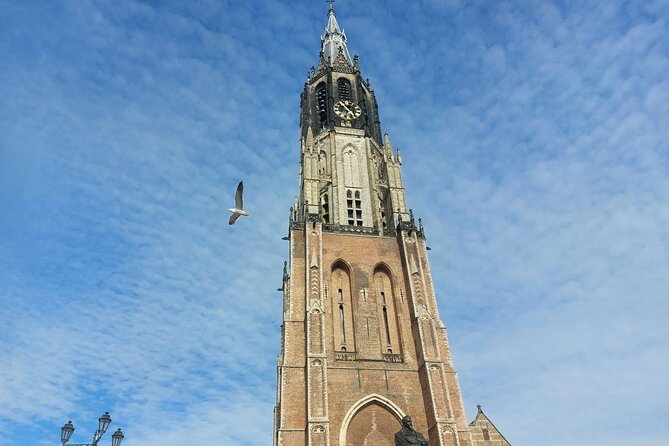
South along the Oude Delft canal, you reach two reminders of Delft’s Golden Age that show up in a very concrete way: the former state weapons armory and the main building of the Delft chamber of the Dutch East India Company.
Your guide connects these sites to Delft’s roles in the military, maritime, and commercial expansion of the Dutch Republic. That’s the bigger picture you may miss if you only focus on churches and painters. Delft didn’t rise because it had one famous resident. It rose because it was part of the systems that built power—ships, weapons, trade routes, and the institutions behind them.
One of the most fun details here is the Vermeer angle. Nearby, you can see the exact location where Johannes Vermeer stood when he painted his famous View of Delft. It’s one thing to admire a painting in a museum space. It’s another to stand near where the scene was framed and let the city’s layout do some of the teaching for you.
All of this stays free for admission at the stops on this walk, which means you can spend your time listening instead of calculating ticket logistics.
Synagogue memory at Vrienden van de Synagoge Delft and a laid-back ending at Beestenmarkt
As the route turns north along Delft’s second-oldest canal—once the city’s grain market—you pass the former synagogue of Delft at Vrienden van de Synagoge Delft. This stop is about presence and continuity. The building reflects the long presence of a Jewish community in Delft, and your guide uses it to broaden the story beyond the usual monuments.
That matters, because Delft isn’t just a stage for the Dutch elite. It’s also a city of merchants, neighbors, workers, and minority communities whose lives shaped daily Delft.
The tour concludes at Beestenmarkt, just behind Markt, where you started. Historically, it was an animal market. Today it’s a lively square with cafés and restaurants. This is a smart finish because you’re placed in the middle of where you’ll actually want to spend time after the tour. If you want a quick beer, casual snacks, or a relaxed dinner, your guide can share local tips to match your pace.
Price and what you’re really paying for (private group up to 15)
The price is $203.22 per group, up to 15 people, for about 2 hours with an English-speaking private guide. That can feel steep if you’re traveling solo or as a couple. But it can look very different when you split it.
Here’s the practical math:
- If your group fills near 15 people, it can work out to roughly $13–14 per person.
- If it’s just 2 people, it’s closer to $100 per person—more like a special activity than a budget walking tour.
So I’d treat this as a value win if you have a small group that wants depth without waiting for a crowd. It’s also a good fit if you’re traveling with kids or seniors, because the private setup gives your guide a chance to adjust pace and route decisions on the fly.
Timing, walking pace, and how to make the route feel easy
This is a walking tour of about 2 hours. The route includes multiple short stop-ins and passes, and you’ll be on your feet most of the time. Comfortable shoes matter more than you think, especially in Dutch weather.
A couple of practical notes that help:
- Plan to wear layers. Even on mild days, canal-side air can feel cooler.
- Keep your phone charged. The tour uses a mobile ticket, and you’ll likely refer to the meeting point and any instructions during check-in.
- If you’re short on time, use the guide’s recommendation for what to do next. The last stop at Beestenmarkt is set up for you to continue with food nearby.
Your guide can also adapt to your group. In the guide style that’s been praised for this tour, you’ll see an emphasis on making it easy for mixed groups—like when there’s a senior traveler or a small child in the group. Guides named Robin and Matyas have been described as flexible and engaging, with humor and clear answers to questions. You don’t need to be a history professor to enjoy it, but you’ll leave with a sense that Delft has logic.
Should you book this Private Walking Tour of Delft?
Book it if you want Delft to make sense fast. This tour is strong when you care about how art, politics, trade, and even water management connect in one city. It’s also an efficient choice: you cover major landmarks in about 2 hours without turning your day into a museum marathon.
Skip or adjust your expectations if you’re mainly chasing one type of stop. If you only want churches or only want Vermeer, you might feel the pacing is a bit mixed. And if your group expects long inside time at each building, you may want to pair this with a separate ticketed museum visit afterward.
If your group is small and you’re paying full private price, I’d consider whether you’ll use the guide time well. Ask questions. Ask for what to see next. This is the kind of tour where the guide’s explanations can justify the cost.
In short: for the right group, this is a high-value way to get Delft’s Golden Age story in a walk you can actually finish with energy left.
FAQ
How long is the private walking tour of Delft?
The tour is about 2 hours.
What is the meeting point for the tour?
You meet at the Hugo Grotius Statue, Markt, 2611 GW Delft, Netherlands.
Is the tour private or shared with other groups?
It’s private. Only your group participates.
How much does the tour cost?
It’s $203.22 per group, for groups of up to 15.
Is pickup available?
Yes. If desired, you can be picked up from any place in the city centre.
What language is the tour offered in?
The tour is offered in English.
Are there admission tickets you need to pay for stops?
The tour lists admission as free at the stops.
How does confirmation work after booking?
You’ll receive confirmation at the time of booking, unless you book within 1 day of travel, in which case confirmation is received as soon as possible based on availability.