REVIEW · AMSTERDAM
The Hague, Delft and Rotterdam Small-Group Tour (Max. 8 People)
Book on Viator →Operated by K7 Travel Amsterdam · Bookable on Viator
Big cities, neatly packaged.
This one-day small-group tour strings together Rotterdam’s modern skyline and rebuilt WWII-era story, Delft’s royal-blue pottery vibe, and The Hague’s international-law and parliament core. You move efficiently by van, then take short walking breaks where the sights actually mean something.
I love how the day mixes “look up and take photos” landmarks (Erasmus Bridge, Cube Houses) with places where you can taste and shop (Rotterdam’s Markthal and Delft’s Markt area). I also like the built-in flexibility: your ticket choice is either Madurodam or the Royal Delft factory experience, so you can pick the style you’ll enjoy more.
One heads-up: the schedule is packed and some stops are mostly exterior views, so this is not the day for slow wandering. Wear comfy shoes, keep your expectations realistic about indoor time at every landmark, and plan for a long day on your feet.
In This Review
- Key takeaways before you go
- Why Rotterdam, Delft, and The Hague in One Day Works
- Small-group pickup and pacing: how this day stays manageable
- Rotterdam stop 1: Markthal’s food-market art (and what to do there)
- Rotterdam on foot: St. Lawrence, Old Harbour, Cube Houses, Erasmus Bridge
- Euromast viewpoint: the 1960 expo tower with bragging rights
- Delft’s Markt and churches: royal-blue city center in 1 focused chunk
- Royal Delft vs Madurodam: pick your kind of Dutch fun
- The Hague’s justice and politics: Peace Palace to the Binnenhof
- How much time you really get at each stop (and why it matters)
- What I’d pack and how I’d handle a long day
- Value check: is $156.07 a good deal for this day?
- Who should book this tour (and who might skip it)
- Should you book this Rotterdam–Delft–The Hague small-group day?
- FAQ
- What time does the tour start, and how does pickup work?
- Where are you picked up in Amsterdam?
- What if my hotel details are missing from the booking?
- How many people are in the group?
- What’s included in the price besides transportation and the guide?
- Do I have to choose between Madurodam and Royal Delft?
- Is lunch provided during the tour?
- What happens if weather is poor or the minimum number of travelers isn’t met?
Key takeaways before you go
- Up to 8 people means you actually hear your guide and move at a sane pace
- Hotel pickup + transport keeps you from wrestling trains for three cities in one day
- Rotterdam’s Markthal gives you a real Dutch food-market stop, not just a photo stop
- Delft’s focus is clear: city center + blue pottery choice (Royal Delft or Madurodam)
- The Hague hits the big themes: international justice + Dutch parliament
- Many stops are short visits, so it’s a sampler day, not a deep study day
Why Rotterdam, Delft, and The Hague in One Day Works
If you have limited time in the Netherlands, you usually face the same problem: Amsterdam is already a lot. This tour fixes that by swapping one heavy city day for a focused “three-city taste.” You get architecture, food culture, royal connections, and government history without the stress of figuring out routes yourself.
Rotterdam is the perfect opener because it shows a city that rebuilt with a modern mindset. Delft adds the slower, prettier counterpoint—canals, a classic market square, and the blue pottery link to the Dutch royal family. The Hague rounds it out with the political and legal side of the country, including buildings tied to international courts and arbitration.
I also like that the day is designed around short, meaningful stops. You’re not stuck in one museum for hours, yet you still get enough time at each place to form a clear impression. That balance is the difference between a good whirlwind and an exhausting blur.
You can also read our reviews of more tours and experiences in Amsterdam.

Small-group pickup and pacing: how this day stays manageable
This tour starts early: the scheduled start time is 8:00 am, and pickup generally happens between 7:45 and 8:30. The company coordinates pickup the day before via WhatsApp or iMessage, so make sure you give a reachable number. When they arrive, you should wait in front of your hotel about five minutes early.
Pickup is offered within the highway ring area A10, with the north part of the IJ river (Het IJ) excluded. If you’re staying north of that area, the guidance is to take a free ferry to Amsterdam Central Station and meet from there. If you didn’t list hotel details in your booking, the tour notes you can only meet at Amsterdam Central Station.
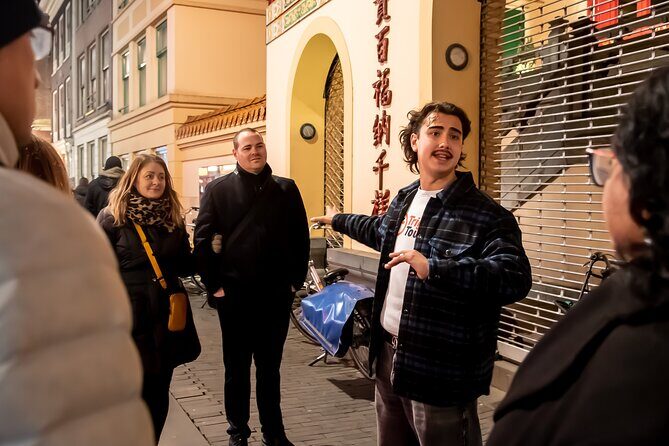
Once you’re on the van, the group size is capped at eight travelers, which helps the pacing. Reviews also point to guides who keep the day moving with a friendly running commentary, with names like Leidse, Pete, Reinier, Erik, and Simon appearing in guide feedback. One practical tip from experience with group tours: for photo stops, bring your camera strap and be ready to move quickly when the van stops.
Rotterdam stop 1: Markthal’s food-market art (and what to do there)
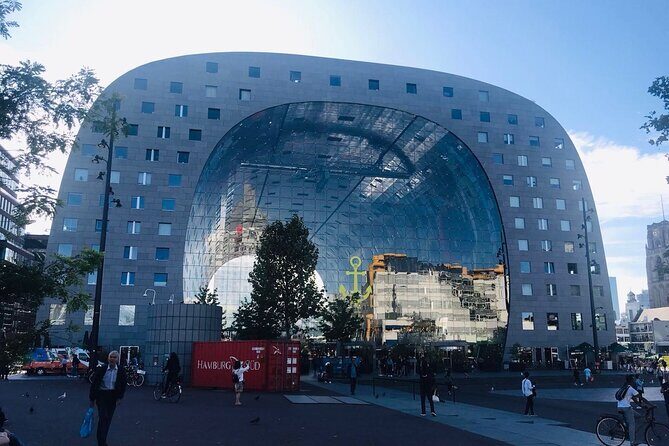
You kick off in Rotterdam at the Markthal, a huge indoor market hall. It’s known for its sweeping interior artwork—nearly 11,000 square meters of painted scenes—and it’s often described as the largest indoor painting area in the world. Admission is free, so this is a strong value start: you can wander, snack, and soak in the atmosphere without spending extra.
This is also where the tour becomes very practical. You can see a wide range of traditional Dutch foods under one roof, including items like cheese, haring fish, and stroopwafel. If you’re new to Dutch flavors, Markthal is a low-pressure place to try something small rather than committing to a full meal later.
How to use your time best: don’t try to “cover everything.” Instead, pick one or two stalls for browsing and one food item for a quick taste. Then you’re ready to move on while your energy is still high.
Rotterdam on foot: St. Lawrence, Old Harbour, Cube Houses, Erasmus Bridge
After Markthal, you visit a sequence of Rotterdam spots that tell different parts of the city story—medieval remnants, WWII-era survival, and bold modern design.
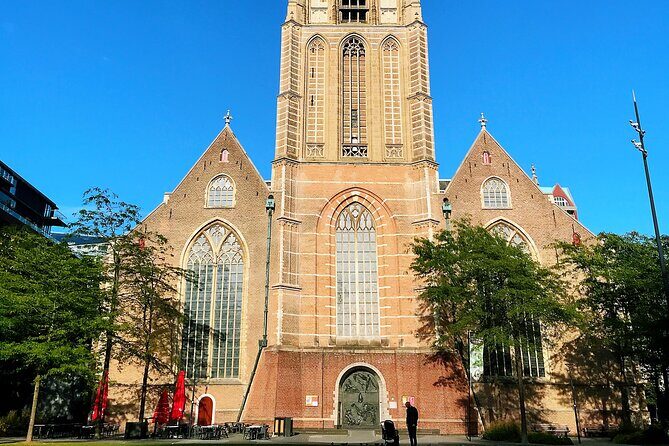
Grote of Sint-Laurenskerk (St. Lawrence Church) is the only remnant of Rotterdam’s medieval city. It’s also noted as the first all-stone building in Rotterdam. The church was destroyed during the Second World War, and after repairs it kept the current magnificent building. Admission is free, and today the space can host exhibitions and concerts, so it often feels like a living venue rather than a dead monument.
Then comes Oude Haven (Old Harbour), Rotterdam’s oldest port, built in 1350. The surroundings are packed with historic buildings, and the harbor area is now lively with bars and restaurants. You can also still spot old barges alongside modern yachts. This is a great walking stretch when you want casual views without being locked into a timed attraction.
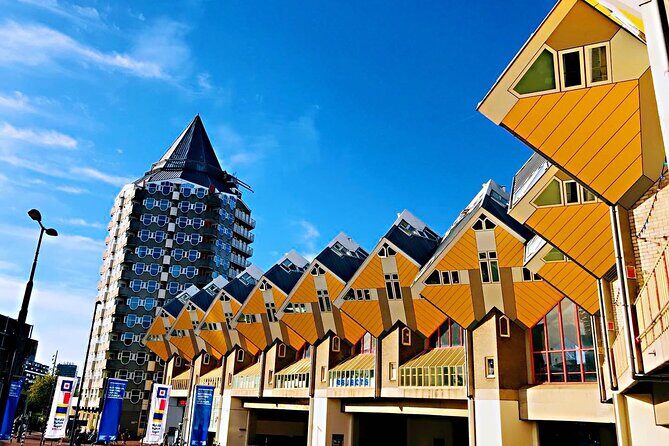
Next are the Kijk-Kubus (Cube Houses)—the famous concept of turning the cube of a conventional house 45 degrees and resting it on a hexagon-shaped pylon. Even when you’re just looking from the outside, the geometry makes you pause and think about how people solve space problems in dense cities.
Finally, you reach the city’s star bridge: Erasmus Bridge. It’s described as a combined cable-stayed and bascule bridge crossing the Nieuwe Maas River, connecting north and south Rotterdam. It’s such a landmark that it even appears in the city’s official logo—perfect for photos, and a good reminder that Rotterdam doesn’t try to hide its modern identity.
Euromast viewpoint: the 1960 expo tower with bragging rights
Your Rotterdam day also includes Euromast, an observation tower built for the 1960 Floriade Flower Expo. It’s listed as a monument since 2010, and the tower is described as the highest building in the Netherlands. It’s also tied to the World Federation of Great Towers, which is a nice way of saying it’s part of a worldwide club of big-city view towers.
What matters for your planning is the role Euromast plays in the tour. Even if you don’t go up, you get the key visual reference point for understanding Rotterdam’s scale and skyline style. If you do decide to go up, treat it as your “big photo moment” for the day, because it tends to give the clearest sense of where the city’s different neighborhoods sit relative to the river.
Tip: if you’re serious about photos, keep your camera settings consistent and watch for wind near viewpoints. Rotterdam’s open-air spaces can feel cool or breezy even when the rest of the day is sunny.


Delft’s Markt and churches: royal-blue city center in 1 focused chunk
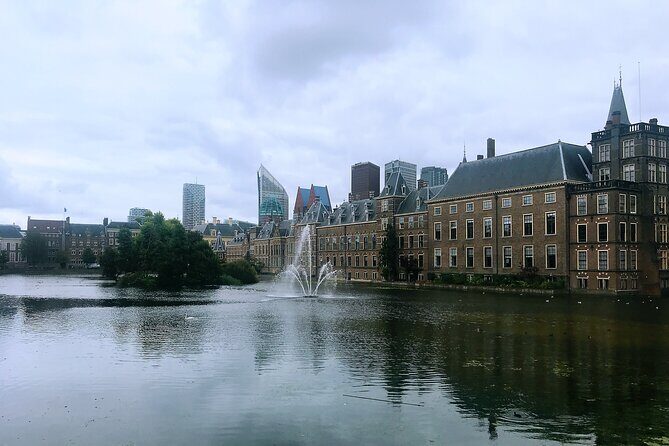
Delft feels like the tour’s change of pace. You roll into a city that’s famous for its connection to the House of Orange-Nassau and for Delft Blue pottery. The stop isn’t about cramming in five museums—it’s about helping you get oriented in the old center and enjoy time to wander at street level.
You start with the area around the city center and Markt, with time built in for lunch on your own. The Delft city hall, Stadhuis Delft, is a Renaissance-style building on the Markt across from the Nieuwe Kerk. It’s also described as the city government seat and a venue for civic wedding ceremonies, while administrative functions have moved into an office inside the Delft railway station building.
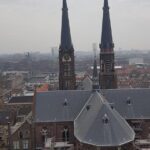
Across the square, the New Church (Nieuwe Kerk) is the other big focal point. It’s a Protestant church, and the tower was completed in 1872. The tower is noted as the second highest in the Netherlands after Utrecht’s Domtoren. Even if you’re not going inside, Delft’s church towers give you that instant sense of place—how the city frames itself around faith, civic identity, and skyline.
Then you have time on Markt Square itself, where you’ll find restaurants, bars, and shops. This is a good place to slow down, sit for a few minutes, and let Delft’s pace settle in. If you’re trying to decide where to eat, scan menus from the square rather than walking far first—you’ll be able to match budget and mood fast.
Royal Delft vs Madurodam: pick your kind of Dutch fun
This is the big “choice” moment in the day, and it’s smart. Instead of forcing both, you only do one: either the Royal Delft Blue Pottery Factory or Madurodam in The Hague.
If you pick Royal Delft, you’re visiting a Dutch manufacturer of Delft Blue earthenware. It’s described as the only remaining factory out of 32 established in Delft during the 17th century. Royal Delft has been active for over 360 years, and you’ll see live painting while you’re there. If you like craft, this option is the one that feels most hands-on, and it connects the city’s art style to real production.
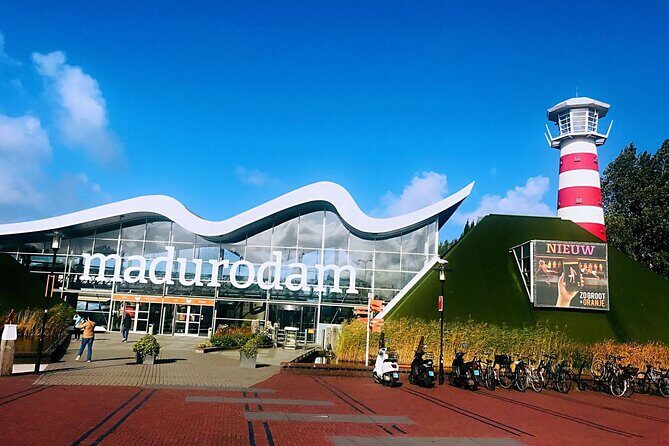
If you pick Madurodam, you’re choosing a different kind of Dutch charm: a miniature city/park of 1.8 square kilometers made up of 1:25 scale replicas. It’s noted as having become the smallest city in the world in 1972, and it brings together more than 120 famous Dutch buildings and historical sites. If you’re traveling with kids, love modelmaking, or want an easy overview of the country’s landmarks, Madurodam is the fun, low-effort pick.
My suggestion: choose Royal Delft if you want something you can look at and take home later in your imagination. Choose Madurodam if you want a quick, easy way to see lots of the Netherlands in one place without walking much.
The Hague’s justice and politics: Peace Palace to the Binnenhof
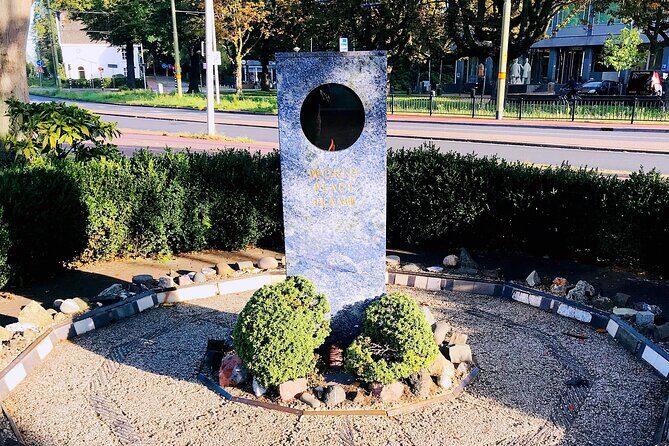
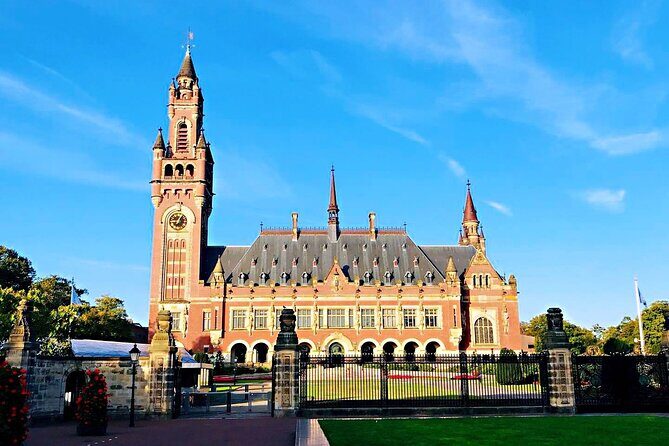
In The Hague, the tour shifts from sightseeing beauty to serious civic themes. You start at the Peace Palace, an international law administrative building. The stop is described as housing the International Court of Justice, the Permanent Court of Arbitration, the Hague Academy of International Law, and the Peace Palace Library. Even if you’re not going deep into legal history, the building carries weight, and the tour frames it clearly as part of how countries negotiate rules outside war.
You then pass by Noordeinde Palace, one of three official palaces of the Dutch royal family. It’s described as the official workplace of King Willem-Alexander since 2013. Expect more of a visual pass-by rather than a long internal visit—still worth it because you get a sense of where modern monarchy operates.
Next is the House of Representatives, part of Dutch parliament. It plays an important role in drafting laws, monitors the government, and decides whether a cabinet has enough confidence. The guide gives enough context to make it understandable, even if you’re not a policy person.
Finally, you reach Binnenhof & Ridderzaal. Binnenhof was built primarily in the 13th century, began as a Gothic castle and residence of the counts of Holland, and became the political center of the Dutch Republic in 1584. It’s also noted as the oldest parliament building in the world still in use. This is one of those stops where you’ll feel why history still matters in daily governance.
How much time you really get at each stop (and why it matters)
This day is a sampler, not a slow tour. The time blocks are short—often 15 to 30 minutes at individual points—so the biggest challenge is not missing sights. It’s staying ready to move and getting the most out of quick moments.
Some stops are designed for quick photo and orientation: Erasmus Bridge, Cube Houses, the outdoor areas around Oude Haven, and the palace exterior passes in The Hague. Other stops reward you more if you actively choose what to do inside: Markthal for snacks, and your one included ticket choice (Royal Delft or Madurodam).
One review also flags that many landmarks are mostly exterior and you can’t enter most of them. That’s normal for a day like this, but it’s worth stating plainly: you’re not buying time to step into every famous building.
Food planning is also key. Lunch isn’t included, but you’ll have time in Delft (and the day includes early stops in Rotterdam) to eat on your own. Bring a small water plan in your head too—your tour includes one bottled water per person, but the Netherlands can still be sunny and walking adds up.
What I’d pack and how I’d handle a long day
Because walking is required and not ideal for slow walkers, I’d pack for comfort over style. A pair of shoes you can trust for cobblestones and museum-tile floors matters more than anything you could buy later. Bring a light layer too; river cities can feel cooler even when the sun looks friendly.
For photos, keep your phone charged and avoid fiddly tasks during stops. If you’re sensitive to sound, note that one review mentioned the guide could be hard to hear from the back of the van, so try to sit where you can listen if that matters to you.
Also think about restroom timing. One review mentioned restroom stops felt inadequate for older people. You don’t need panic planning, but do expect that the schedule doesn’t revolve around long bathroom breaks.
If you’re a real art fan, here’s a helpful detail from guide behavior: one guest described a guide making time for the Mauritshuis to see Vermeer’s Girl with a Pearl Earring. That’s not guaranteed in the written schedule, but it’s a sign that some guides may try to accommodate special interests when timing allows.
Value check: is $156.07 a good deal for this day?
Price is always personal, but here’s the math you can use. At $156.07 per person, you’re paying for a full day of transport, a guide, and pickup from your hotel area (with clear pickup rules). You also receive one bottled water per person, plus the entrance ticket for either Madurodam or Royal Delft.
Then there’s the hidden value: Rotterdam’s highlights like Markthal, St. Lawrence Church, and Peace Palace are listed as free admission stops, so you’re not doubling your costs by choosing a tour that piles on paid entries. The one paid ticket gives you a real anchor experience without turning the day into a museum marathon.
If you were to plan this yourself, you’d likely spend time figuring out logistics, paying for transit, and stitching together three separate city days. This tour buys you structure—and because it caps at eight people, you’re not stuck in the “hundreds of voices” chaos.
Who should book this tour (and who might skip it)
This is a great choice if you want a first, fast feel for three major Dutch cities without renting a car or managing transfers. It’s also ideal for people who like mixed stops: a food hall in one city, craft or miniature sightseeing in another, and civic buildings in the third.
You’ll probably enjoy it if you’re okay with short visits and you can walk at a steady pace. The tour warns it’s not recommended for slow walkers, and the schedule has enough movement that you should respect that.
If you’re the type who likes long museum sessions, deep reading, and lots of time in one place, you might feel rushed. Also if entering buildings is your top priority, remember that many famous points are likely exterior views.
Should you book this Rotterdam–Delft–The Hague small-group day?
I’d book it if you want a high-value sampler day that reduces planning work and keeps the group small. Rotterdam’s Markthal start, Delft’s Markt-and-church orientation, and The Hague’s Peace Palace to Binnenhof sequence create a day with clear contrasts, not random stops.
You might skip it if you hate long days, prefer slow pacing, or expect to enter every landmark you photograph. In that case, a slower, single-city plan (or two separate days) will match your style better.
If you do decide to go, book early. The tour notes that it’s commonly booked about 72 days in advance, which usually means you should not wait for the last minute.
FAQ
What time does the tour start, and how does pickup work?
The tour starts at 8:00 am. Pickup is offered between 7:45 and 8:30, and you’ll be contacted the day before via WhatsApp or iMessage to confirm details.
Where are you picked up in Amsterdam?
Pickup is offered for locations in the Highway Ring A10, excluding the north part of the IJ river (Het IJ). If you are in the excluded north area, the guidance is to take the free ferry to Amsterdam Central Station.
What if my hotel details are missing from the booking?
If there is no hotel information in your booking, you can meet only at Amsterdam Central Station.
How many people are in the group?
The tour is capped at a maximum of eight travelers.
What’s included in the price besides transportation and the guide?
Your included items are hotel pickup service, one bottled water per person, and an entrance ticket to either Madurodam or the Royal Delft factory (depending on which option you select). Lunch is not included.
Do I have to choose between Madurodam and Royal Delft?
Yes. You visit either Madurodam or the Royal Delft Blue Pottery Factory, but not both.
Is lunch provided during the tour?
No, lunch is not included. The schedule includes time in Delft where you can choose your own lunch.
What happens if weather is poor or the minimum number of travelers isn’t met?
The experience requires good weather. If it’s canceled due to poor weather, you’ll be offered a different date or a full refund. If it’s canceled because the minimum isn’t met, you’ll be offered a different experience or a full refund.