REVIEW · UTRECHT
e-Scavenger hunt Utrecht: Explore the city at your own pace
Book on Viator →Operated by Qula · Bookable on Viator
Utrecht can be a lot faster to enjoy. This mobile e-Scavenger hunt turns the center into a walkable game, with educational questions that guide you to landmarks you might otherwise miss, like Dom Tower and the flower market. I like that you can set your own pace, pause for photos, and even take a detour for lunch. One possible drawback: a small number of puzzle check-ins can feel fiddly if the app pinpoints don’t match where you’re standing, so be ready for a bit of searching.
This is priced per group (up to 6), and it’s designed so small or large friend groups can enjoy the route together. You’ll start at Domplein 20 and finish back where you began, typically in about 2 to 4 hours. You do need your own smartphone and data, since those aren’t included—so plan to have a working connection before you launch the hunt.
In This Review
- Key points to know before you start
- Why this Utrecht hunt feels different than a normal walking tour
- Price and value: what you’re actually paying for
- Getting started at Domplein 20 (and staying on track)
- Stop by Stop: what you’ll see and why it matters
- 1) Dom Tower of Utrecht: Utrecht’s symbol in 112.5 meters
- 2) Self-playing musical instruments: music-box to barrel organs
- 3) Another church layer: oldest foundations in the center
- 4) The flower market: color, variety, and a great pause
- 5) Oudegracht canals: restaurants with a postcard backdrop
- 6) Utrecht University botanic garden: a former fort’s quiet history
- 7) Railway Museum: not just tracks and tickets
- 8) Neude square: a name that remembers swampy origins
- 9) Nicolaïkerk: a church stop that feels like part of the neighborhood
- 10) De Zeven Steegjes: working-class Utrecht by the canal
- 11) Janskerk: founded shortly after 1040 by Bishop Bernold
- 12) Utrecht City Hall: oldest roots dating to 806
- 13) Paushuize at Pausdam: early 1500s monumental building
- 14) Agnietenstraat rococo building: boarding school for orphaned boys
- 15) Sterrehof courtyard: atmospheric and protected
- How long it really takes (and how to make it enjoyable)
- A fair look at the drawbacks: app friction and answer explanations
- Practical tips to get the best day out of it
- Should you book the e-Scavenger hunt in Utrecht?
- FAQ
- How long does the e-Scavenger hunt in Utrecht take?
- Where does the hunt start and end?
- How many people can join per group?
- What language is the experience offered in?
- Do I need a smartphone or data?
- Is this a private activity?
- What types of places are included on the route?
- Can I start the hunt any time during the day?
- When will I get confirmation after booking?
- Is there a cancellation policy for a full refund?
- Is it suitable for hearing-impaired travelers?
Key points to know before you start
- A self-paced city trail: you control the walking pace, breaks, and photo stops
- Dom Tower and canal Utrecht: the route mixes big icons with calmer streets
- Interactive, educational questions: you learn while you move, not in a lecture
- Bonus points in the app: clicking these at locations can add fun and structure
- Good for groups up to 6: one price covers the team size
- Some stops can be location-sensitive: have patience if the pin is off a little
Why this Utrecht hunt feels different than a normal walking tour

A classic walking tour gives you facts at set times. This format flips it. You get a route through Utrecht, but the pace stays yours. That matters in a place like Utrecht, where the best moments often happen in between sights—on a canal-side patio, in a small lane, or while you’re circling back for one more angle of a church tower.
The hunt is also built around doing. Questions are short, interactive, and aimed at making you look closer—at architecture, street names, and the city’s layers. That’s especially useful in Utrecht because you’ll pass medieval churches, civic buildings with deep roots, and quieter courtyards that feel tucked away even when you’re in the center.
I also like that the experience is run for a private group. With up to 6 people under one group booking, it’s easier to move together, argue playfully about answers, and keep kids (or adults) engaged without turning the day into a herding exercise.
You can also read our reviews of more city tours in Utrecht


Price and value: what you’re actually paying for
The price is $37.21 per group (up to 6), with a typical duration of 2 to 4 hours. That turns into very different value depending on your team size:
- If you fill all 6 spots, you’re effectively paying around $6 per person for a self-guided, app-driven city experience.
- If it’s just 2 or 3 of you, your per-person cost goes up—but you’re still buying time on your feet plus an organized route that returns you to your starting point.
What makes it feel fair isn’t just the sights. It’s the structure. The hunt gives you a reason to walk between neighborhoods you might skip on a quick visit, like the working-class lanes by the Oudegracht and the smaller courtyards near the center.
Getting started at Domplein 20 (and staying on track)

You meet at Domplein 20, 3512 JD Utrecht, right by Utrecht’s most recognizable skyline piece: Dom Tower. Starting here is smart. You get instant orientation. You’ll also finish the experience back at the meeting point, so you’re not left stranded across town.
You’ll receive confirmation when you book, and the trail can be started any day within the long listed opening window (it’s shown as open daily, 12:00 AM to 11:59 PM). Practically, that means you can choose a time that fits daylight and crowds.
One more practical tip: the app includes bonus points at locations. If you want the full game feeling, don’t forget to check those when you arrive.
Stop by Stop: what you’ll see and why it matters
1) Dom Tower of Utrecht: Utrecht’s symbol in 112.5 meters
The route begins with Dom Tower of Utrecht, the tallest church tower in the Netherlands at 112.5 metres. Even if you don’t climb it, you’ll understand quickly why it’s treated as Utrecht’s symbol. The tower anchors the city’s center, and it’s the kind of landmark that helps you navigate on foot.
You’ll also encounter the deeper story of the church complex here. Construction began in 1039, and it was inaugurated on 1 May 1048. That medieval timeline gives you something concrete to look for as you walk—because Utrecht’s buildings don’t feel random when you know you’re in a place that’s been forming for nearly a thousand years.



2) Self-playing musical instruments: music-box to barrel organs
Next comes a stop built around self-playing musical instruments, from music boxes to clocks, pianolas, and barrel organs. This isn’t just a quirky diversion. It’s a reminder that Utrecht isn’t only churches and canals—people here also built technology and performance into everyday life.
Expect this part of the route to feel more indoor and focused than the outdoor streets. If you’re traveling with mixed-age groups, this kind of stop often keeps attention without needing long text explanations.
3) Another church layer: oldest foundations in the center
You’ll pass an area tied to one of the city’s oldest church moments, with the construction and inauguration dates already noted above. The big win is perspective. When you walk past churches in Utrecht without context, they can blend together. With the hunt format, you’re prompted to connect what you see today to what started in the 11th century.
4) The flower market: color, variety, and a great pause
Then you reach the flower market, described as very colorful and comfortably busy. This is one of those Utrecht moments that isn’t just photogenic—it’s a sensory reset. You’ll see an amazing array of cut flowers and plants, and it’s worth slowing down even if you’re in a hurry.
It’s also a smart timing stop. Markets work best mid-walk when you need a reset anyway. If you want to buy small souvenirs like bulbs or bouquets, this is the easiest place to do it without changing your whole plan.
5) Oudegracht canals: restaurants with a postcard backdrop
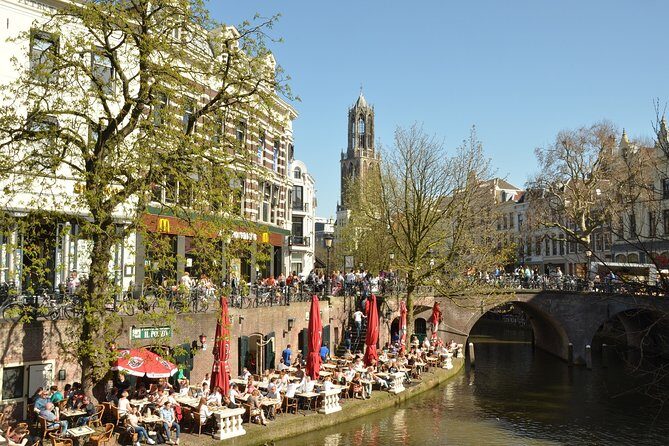
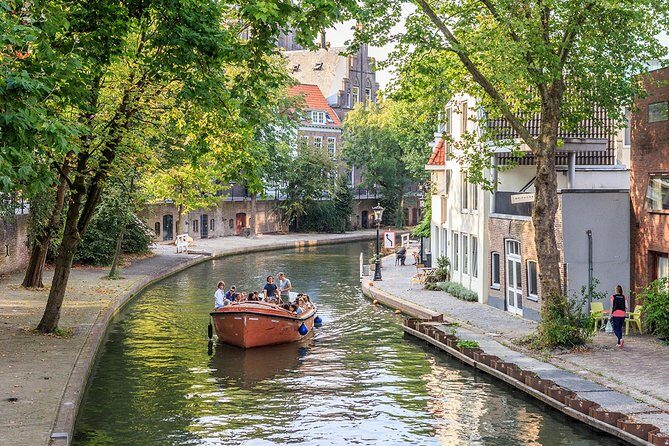
Utrecht’s canals are the city’s live background, and the hunt leads you to Oudegracht, the old canal running through the center. It’s famous—and worth a visit—because the canal-side streets feel both historic and fully functional today, with restaurants and a steady flow of people.
As you work through the questions, you’ll likely notice how the city’s canal structure shapes where shops sit, where you pause, and how neighborhoods connect. This is where the self-guided format shines: you can stop when the view is best, not when a tour guide says it’s time.
6) Utrecht University botanic garden: a former fort’s quiet history
Next you head to a botanic garden on the Utrecht University campus, located around a former fort. It’s part of the so-called Holland Water Defence. That combination—nature and defense history—makes this stop feel more interesting than a typical garden stroll.
If you like your scenic stops with a story, this is a strong one. It also offers a different pace from the market and canal areas. Expect it to feel calmer, more walk-and-look, less busy-shopping.
7) Railway Museum: not just tracks and tickets
The route includes what’s described as the most exciting train station in the Netherlands, with the Railway Museum offered as more than a standard museum stop. This is a chance to break up the walking with something interactive that fits the theme of Utrecht as a place of design and technology, not only heritage buildings.
8) Neude square: a name that remembers swampy origins
You’ll visit Neude, and the hunt gives you the clue that the name comes from node, meaning swamp. That kind of detail changes how you see a square. It’s no longer just a place to pass through—it becomes proof the city’s geography has shifted and evolved over time.
For the practical-minded: squares like Neude are also convenient waypoints. They’re open, easy to find, and make it easier to regroup if someone’s phone battery runs low.
9) Nicolaïkerk: a church stop that feels like part of the neighborhood
Another religious stop appears with Nicolaïkerk, located at Nicolaaskerkhof 8 and popularly known as Nicolaaskerk. This is the kind of stop that works well inside a game format. You don’t need a lecture; you just need to look closely, read the question prompt, and connect the building to the answer.
10) De Zeven Steegjes: working-class Utrecht by the canal
You’ll also walk through De Zeven Steegjes, described as one of the last working-class neighborhoods in the center. These characteristic workers’ houses near the Oudegracht are the opposite of a theme-park view. They feel lived-in, narrow, and human-scaled.
This is one of the best reasons to do a city trail instead of a straight-line checklist. The route nudges you into a part of the city that helps you understand the Utrecht beyond the postcard angles.
11) Janskerk: founded shortly after 1040 by Bishop Bernold
Then comes Janskerk on Janskerkhof. Construction is tied to Bishop Bernold, with the church founded shortly after 1040 and dedicated to John the Baptist. Even if you don’t memorize all dates, it gives you a clear anchor for why the church feels so old in a city where buildings still show their age.
12) Utrecht City Hall: oldest roots dating to 806
Next is the city hall of Utrecht, with a claim that the oldest parts date from 806, and after about five centuries, it looks the way you recognize today. This is a great stop for anyone who likes civic power and medieval governance. City halls aren’t only bureaucratic boxes here—they reflect long continuity.
13) Paushuize at Pausdam: early 1500s monumental building
You’ll pass Paushuize, built at the beginning of the sixteenth century and located on Pausdam. This is another “look closer” moment. Big dates help you see the style more accurately as something built, used, and maintained across centuries.
14) Agnietenstraat rococo building: boarding school for orphaned boys
Another standout stop is the foundation building on Agnietenstraat, completed in 1761. It originally served as a boarding school for orphaned boys and is highlighted for rococo style in the Netherlands. If you like architecture that shows a specific time period, this can feel like a payoff after you’ve spent earlier parts of the route in medieval time.
15) Sterrehof courtyard: atmospheric and protected
The route ends with Sterrehof, a courtyard valued as a national monument. Courtyards can be hard to find on your own, and that’s part of the value here. You get an atmospheric space that feels separate from the main street energy, even while you’re still inside the center.
How long it really takes (and how to make it enjoyable)
The listed duration is 2 to 4 hours. In practice, your pace depends on how many pauses you take. One helpful reality check: if you slow down, deviate a bit, and stop for lunch and drinks, you can easily extend the walk—and it may land around 10 km for a fuller day.
So if you have a tight schedule, treat the hunt like a structured walk with planned stops. If you want a relaxed day, treat it as a route with built-in reasons to stop, then let the city pull you off the straight line.
Also, this is set up for all ages and works for groups with different ages, which makes it a good family option if you want to avoid a long scripted tour.
A fair look at the drawbacks: app friction and answer explanations

Every puzzle game has friction points, and this one has a few worth knowing. Some people report that pinpoints can be way out of reach, making it harder to get answers without extra wandering. The good news is that the game includes checking on-site if something is off, so you’re not necessarily stuck forever.
Another small downside: some puzzle prompts may feel a bit under-explained. The hunt gives answers, but it may not always satisfy if you want deep background on every fact. If that’s your style, keep a bit of flexibility. You can always look up a building name later, but the walk can still be fun even if you don’t get a full academic explanation at each stop.
Practical tips to get the best day out of it
- Bring a fully charged phone and double-check your connection since smartphone and data aren’t included.
- If you like a playful format, plan for a little team competition. The app has scoring features and bonus prompts.
- Wear good walking shoes. Utrecht’s center is compact, but you’ll still be on your feet for a while.
- Keep an eye out for times when you might need to regroup, especially if your team splits briefly to zoom in on details.
And one more: you don’t need to rush through. The whole point is learning while walking. Slow is part of the design.
Should you book the e-Scavenger hunt in Utrecht?

I’d book this if you want Utrecht at walking speed, with a game that gives you structure without locking you into a rigid schedule. It’s strong value for groups up to 6, and the route is a real mix: Dom Tower, canals and markets, church stops, and even a museum-themed break with the Railway Museum.
I’d hesitate only if you hate any app-based timing, or if you get frustrated easily when a location pin doesn’t match reality. If you’re the type who enjoys a bit of searching and likes learning through questions, this is a fun way to see more of Utrecht than a simple checklist.
FAQ
How long does the e-Scavenger hunt in Utrecht take?
The hunt is designed for about 2 to 4 hours.
Where does the hunt start and end?
It starts at Domplein 20, 3512 JD Utrecht, Netherlands and ends back at the same meeting point.
How many people can join per group?
The price is for a group of up to 6 people.
What language is the experience offered in?
The hunt is offered in English.
Do I need a smartphone or data?
Yes. A smartphone and data are not included, so you’ll need your own phone and connectivity to run the mobile experience.
Is this a private activity?
Yes. It’s private, meaning only your group participates.
What types of places are included on the route?
The route includes major sights and variety stops like Dom Tower, the flower market, the Oudegracht canal, churches such as Nicolaïkerk and Janskerk, Utrecht City Hall, and stops including the Railway Museum, plus courtyards like Sterrehof.
Can I start the hunt any time during the day?
The hours listed show it’s available daily from 12:00 AM to 11:59 PM.
When will I get confirmation after booking?
Confirmation is received at the time of booking.
Is there a cancellation policy for a full refund?
Yes. You can cancel up to 24 hours in advance for a full refund.
Is it suitable for hearing-impaired travelers?
The experience is listed as user-friendly for hearing impaired.