REVIEW · AMSTERDAM
Amsterdam Pedicab City Tour (2 hours)
Book on Viator →Operated by Bram de Haan · Bookable on Viator
Some cities feel fast. Amsterdam can feel slower.
This 2-hour private pedicab tour is a smart way to see a wide slice of the center without burning your legs on cobblestones. You’ll glide past major landmarks and lesser-known streets, then get the local context that turns simple sights into a clear picture of how the city grew.
What I like most is the private guide pace—the kind where you can pause for photos and ask questions without watching the clock like it’s a school bell. You also get a guide who explains the why behind what you see, with old maps and photos that help you compare Amsterdam yesterday to Amsterdam today.
One thing to consider: this is priced per group (up to 2), and the pedicab has a total passenger weight limit of 210 kg. Also, the experience requires good weather, so you’ll want a flexible plan if skies turn sour.
In This Review
- Key highlights at a glance
- Eco-Friendly Pedicab City Tour: What You’re Really Buying
- Stop by Stop: Dam Square to the Canal Ring
- Dam Square: where Amsterdam’s story starts
- Zeedijk: the oldest dike and a darker story
- Chinatown: history right next to everyday shopping
- Nieuwmarkt: the old city gate and a big “before” moment
- Montelbaanstoren: a watch tower with canal views
- Rembrandt House Museum: outside views only
- Jodenbuurt: what survived after WWII
- Portuguese Synagogue: largest, built in 1675
- National Holocaust Names Monument: a wall of names
- H’ART Museum: Hermitage roots, changed use
- Magere Brug: canals, lights, and a classic view
- Canal Ring (Grachtengordel): half circles of merchants
- Museumplein, Rijksmuseum Views, and a Bicycle Tunnel Moment
- Museumplein: Rijksmuseum, Concertgebouw, and the art cluster
- Through the bicycle tunnel area: a fun Amsterdam detail
- Back view of the Rijksmuseum: Pierre Cuypers’ 1885 design
- Rain-Proofing, Photo Timing, and How the Private Pace Feels
- Price and Value: Why This Costs What It Costs
- Who This Pedicab Tour Fits Best
- Should You Book This Amsterdam Pedicab Tour?
- FAQ
- How long is the Amsterdam pedicab city tour?
- What is the price for the Amsterdam pedicab tour?
- Is this tour private?
- Is pickup included?
- Does the tour include museum admission?
- What language is the tour offered in?
- Are snacks included?
- Is a mobile ticket provided?
- What’s the passenger weight limit?
- What happens if weather is bad?
- What’s the cancellation window?
Key highlights at a glance
- Private pedicab for up to 2: see more than walking tours while staying personal
- Guide Bram de Haan: uses maps, photos, and drawings to explain Amsterdam’s changes
- Short photo stops built into the route: you get views without long lines
- Jewish Amsterdam stops: Jodenbuurt, Portuguese Synagogue exterior, and the Holocaust Names Monument
- Classic Amsterdam canals: canal ring views plus the iconic Magere Brug photo spot
- Rijksmuseum area route: including a pass through the bicycle tunnel area and a great museum back view
Eco-Friendly Pedicab City Tour: What You’re Really Buying
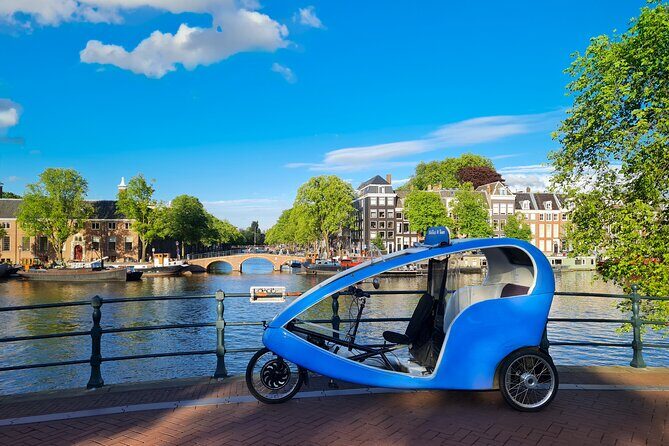
You’re not just buying a ride. You’re buying a guided orientation to the city that’s faster than walking, but still human-scale.
On this tour, the pedicab does two big jobs. First, it helps you cover a lot of ground in about 2 hours without treating Amsterdam like a cardio workout. Second, it gives your guide room to weave in details while you’re moving between neighborhoods, canals, and landmarks.
The setup is also practical. You’ll have pickup offered, and the meeting point is straightforward: wait in front of your hotel and look for the blue pedicab. Your ticket is mobile, and the tour runs in English. Most people can join, and there’s an important ceiling: total passenger weight can’t exceed 210 kg.
The vibe is not rushed. It’s more like a focused conversation with wheels—your guide can pull over when you want a picture or a bit more explanation, and you don’t have to follow a group that’s trying to keep 15 people together.
You can also read our reviews of more city tours in Amsterdam



Stop by Stop: Dam Square to the Canal Ring
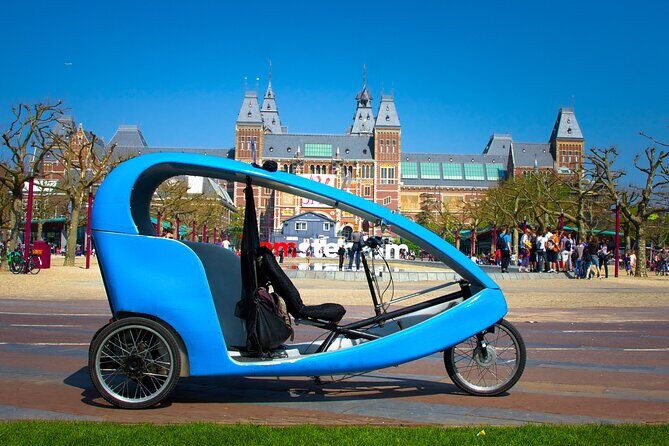
This route is designed like a guided loop through what you’d call the “center of the center.” You’ll hit iconic spots, then connect the dots so your first day (or first half-day) makes sense.
Dam Square: where Amsterdam’s story starts
Your tour begins at Dam Square, the heart of old Amsterdam. It’s the main square where you’ll find the Royal Palace, the New Church, and the National Monument. Even if you’ve seen photos, standing near the palace area helps you understand why this place became a public stage for centuries of civic life.
The stop is brief—around 5 minutes—so think of it as a fast orientation: location, atmosphere, and what surrounds it.
Zeedijk: the oldest dike and a darker story
Next is Zeedijk, one of the oldest dikes around the old center. You’ll also hear about the oldest café of Amsterdam, known for its original interior and an ancient feel.
One twist here: the tour description hints at a darker secret the guide will explain. Even with only a few minutes, this is the kind of storytelling that makes a street name stick in your memory.
Chinatown: history right next to everyday shopping
You’ll pass through Chinatown, described as the oldest Chinese neighborhood on the European mainland. It’s not a theme park. Expect a mix of restaurants, supermarkets, and a Chinese temple.
This stop is short (about 5 minutes), but the value is in the context: how immigrant communities became part of the city’s fabric over time.
You can also read our reviews of more tours and experiences in Amsterdam






Nieuwmarkt: the old city gate and a big “before” moment
At Nieuwmarkt, you’ll learn about the old citygate, the main entrance to Amsterdam when it was a walled fortified city. Until the big 17th-century expansion, this area mattered for defense and movement.
The guide uses this stop to connect how the city’s borders changed, which makes the rest of the tour feel less random. Plan for about 10 minutes here.
Montelbaanstoren: a watch tower with canal views
Then comes Montelbaanstoren, an early 16th-century watch tower that belonged to Amsterdam’s defensive line. It’s also a viewpoint over de oude Waal, where you can see houseboats aligned in front of classic canal houses.
At about 5 minutes, it’s quick, but it’s the kind of place where a photo plus a short explanation gives you a lot of payoff.
Rembrandt House Museum: outside views only
You’ll look at Rembrandt’s house from the outside, where he lived during some of his successful years. You can enter the museum on other tickets, but museum entry isn’t included here.
That’s not a deal-breaker. For many people, this is enough to say, yes, I stood where he lived, without adding a line-and-ticket step.
Jodenbuurt: what survived after WWII
Next is Jodenbuurt, the old Jewish neighborhood in the center. A large part was destroyed after the Second World War, but some synagogues, buildings, and streets remain. You’ll see what lasted, and you’ll also understand that “survival” in a city has a meaning beyond bricks—it shapes memory and identity.
This stop runs about 10 minutes, so it’s one of the longer stretches.
Portuguese Synagogue: largest, built in 1675
You’ll then stop near the Portuguese Synagogue of Amsterdam, the largest synagogue and one of the earliest places where Jewish people were allowed to build in Western Europe in the late 17th century (1675).
Again, this one is an exterior-focused moment, and the tour includes looking at other synagogues opposite that now form part of the Jewish museum area. Time is around 5 minutes.
National Holocaust Names Monument: a wall of names
From there, you’ll pass by the National Holocaust Names Monument, where 102,000 brick stones carry names. This is one of those stops where you’ll probably want a quiet minute, even if you don’t fully take it in at first glance.
Time is short (about 2 minutes), but the impact is big.
H’ART Museum: Hermitage roots, changed use
You’ll pass by the H’ART Museum, connected to the Hermitage story. The building used to be a monumental large widowhouse care house built in the 17th century. Now it’s part of the Russian Hermitage network.
This stop is more about the layers you can’t see at street level unless someone explains them—about 2 minutes as you drive through.
Magere Brug: canals, lights, and a classic view
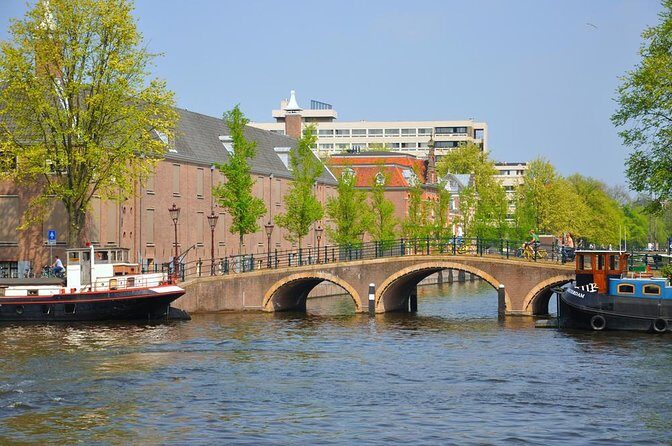
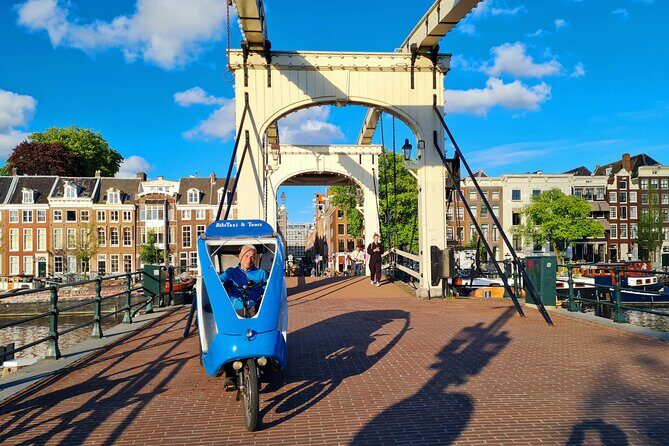
Now for one of Amsterdam’s most famous postcard angles: Magere Brug, the skinny bridge over the Amstel. At night it’s known for lighting up with hundreds of bulbs, but even in daylight, the bridge works because of the canal perspective.
You’ll get a good overview over the Amstel, and it’s also an easy photo stop. Plan around 5 minutes.
Canal Ring (Grachtengordel): half circles of merchants
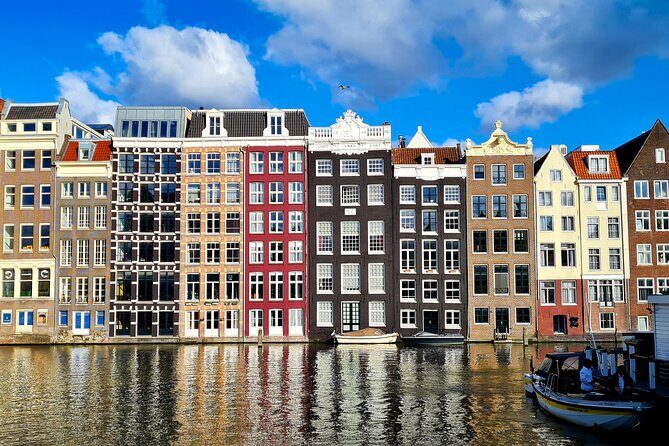
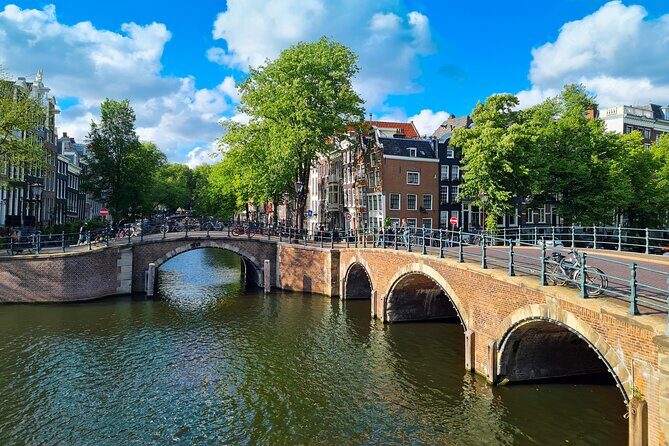
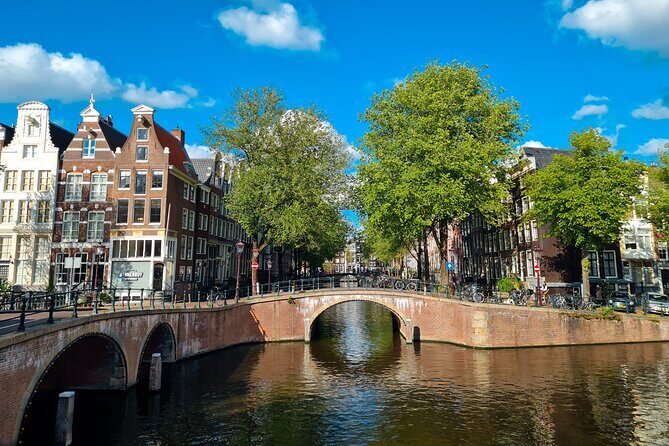
Finally in this stretch, you’ll see the Canal Ring, the 17th-century expansion that forms those half-circle arcs around the old center. The classic canal houses were often homes of successful merchants, and the guide will point out patterns—how the houses differ while still sharing recognizable building traits.
This part gets about 10 minutes, enough time to absorb the shape and then understand why Amsterdam’s canal layout is so famous.
Museumplein, Rijksmuseum Views, and a Bicycle Tunnel Moment
If Dam Square is the start of Amsterdam’s public story, Museumplein is a different kind of spotlight: art, music, and big institutions, right in the city center.
Museumplein: Rijksmuseum, Concertgebouw, and the art cluster
At Museumplein, you’ll see the Rijksmuseum on one side and the Concertgebouw concert hall on the other. The tour time here is about 10 minutes, and your guide will add detail on what you’re looking at.
It also sits next to other big museum names—Van Gogh Museum, Stedelijk Museum, Moco museum, and the Diamond museum—so even if you don’t enter any of them today, you leave with a clear map of where they all sit.
Through the bicycle tunnel area: a fun Amsterdam detail
After Museumplein, you’ll pass through the famous bicycle tunnel under the Rijksmuseum, where you can often hear street performers playing classical music. It’s one of those Amsterdam moments where the city’s daily life is right next to grand architecture.
This is a quick segment, but it’s memorable because it feels oddly specific and local.
Back view of the Rijksmuseum: Pierre Cuypers’ 1885 design
Then you’ll head toward a spot for a really good view of the back of the Rijksmuseum, completed in 1885 and designed by the Catholic architect Pierre Cuypers. Front views get all the attention. Back views help you appreciate the building’s scale and how it sits in the square.
You’re not spending hours here, but the guide’s angle makes it worth the stop.
Rain-Proofing, Photo Timing, and How the Private Pace Feels
Amsterdam weather can do a quick plot twist. Here’s the comfort part: the tour includes a waterproof blanket you can pull over yourselves if rain hits. Several people mention getting caught by rain without getting soaked, which matters on a cool day.
The pedicab ride itself is also designed for comfort. The reviews you provided highlight that it’s easy to get on and off, and it feels comfortable for a couple. That matters because you’re sitting for part of the time, and you don’t want an awkward, cramped ride to ruin the sightseeing.
Also, your guide’s timing is flexible. If you want a photo with a bridge, or if you want extra explanation at a memorial, the guide can stop when needed. That flexibility is one of the biggest differences between a private pedicab and a fixed-route bus tour.
One more practical note: this tour includes many short stops, so if your goal is long museum time, you’ll want to treat this as a first-day orientation and then come back later for entrances.
Price and Value: Why This Costs What It Costs

The price is $237.65 per group, with a maximum group size of up to 2. So yes, it’s not the cheapest way to move around Amsterdam. But the math changes when you compare it to the alternatives.
With a private tour, you’re paying for:
- No crowd management (you don’t have to wait for a big group)
- More tailored pacing (your questions and photo stops matter)
- A true local voice with historical comparisons using old maps and photos
- Comfort and coverage in a city where walking between neighborhoods can add up fast
For two people, that price works out to roughly $120 per person for about two hours of guided sightseeing. If you’re splitting costs with a partner, it can feel more reasonable than per-person group tours—especially because the pedicab helps you see a lot without the fatigue that leads people to cut their sightseeing plans short.
Also, transport is included. And those short stops let you sample lots of major areas without committing to museum admissions during the ride.
Who This Pedicab Tour Fits Best
This experience is ideal if you:
- Want a first introduction to Amsterdam and want it to make sense fast
- Prefer a route that avoids major walking stretches while still covering big landmarks
- Like history explained through real visuals like old photos and maps
- Care about photo opportunities at places like Dam Square, Magere Brug, and the canal ring
It may not be the best fit if you:
- Want to spend lots of time inside museums (this tour is mostly exterior views and brief stops)
- Have very specific interests that need long research time at one site
- Are traveling with weight needs that might exceed the 210 kg total limit
Should You Book This Amsterdam Pedicab Tour?
If you have limited time and you want a strong orientation across central Amsterdam, I think this is a smart booking. The combination of private pacing, a guide who explains connections between neighborhoods, and the practical comfort of a pedicab makes it feel like more than a sightseeing shortcut.
Book it if your goal is to leave with a clearer mental map: where key landmarks are, how the city expanded, and why the canals and districts look the way they do. Skip it if you want long museum entries or you’d rather spend that time doing fewer sites in more depth.
If you’re planning your first day in Amsterdam, this tour is the kind of start that makes the rest of your trip easier.
FAQ
How long is the Amsterdam pedicab city tour?
The tour is scheduled for about 2 hours.
What is the price for the Amsterdam pedicab tour?
The price is $237.65 per group (up to 2 people).
Is this tour private?
Yes. It’s a private tour/activity, and only your group participates.
Is pickup included?
Pickup is offered, and you should wait in front of your hotel looking for the blue pedicab.
Does the tour include museum admission?
Some stops are exterior-only, such as the Rembrandt House Museum (entry is possible but not included). The tour’s stops list indicates admission tickets are free for the places mentioned, but museum entry is not included where noted.
What language is the tour offered in?
The tour is offered in English.
Are snacks included?
No. Snacks are not included.
Is a mobile ticket provided?
Yes. You’ll receive a mobile ticket.
What’s the passenger weight limit?
The maximum total passenger weight is limited to 210 kg.
What happens if weather is bad?
This experience requires good weather. If it’s canceled due to poor weather, you’ll be offered a different date or a full refund.
What’s the cancellation window?
You can cancel for a full refund up to 24 hours in advance of the experience start time. If you cancel less than 24 hours before, the amount paid is not refunded.