REVIEW · AMSTERDAM
Amsterdam: Historic City Sightseeing Canal Cruise
Book on Viator →Operated by Amsterdam Circle Line · Bookable on Viator
This cruise is a fast way to get your bearings and read the city from the water. In about an hour, you glide past centuries of canal life, from historic canal houses and churches to modern showpieces, with commentary in English to stitch it all together.
I especially like that the meeting point is right by the Anne Frank House, so you can line up this cruise with a museum visit without wasting time zigzagging across town. And I like the value: at around $18.71 per person, it’s a compact way to see a lot without locking up half a day.
One thing to consider: the narration is mainly audio/recorded, so if you sit in the wrong spot on a windy day, you might miss details. You’ll still see plenty, but the information is where the cruise can feel uneven.
In This Review
- Quick reasons this 1-hour cruise works
- Why this 1-hour canal cruise is such a smart first-day plan
- Meeting at Anne Frank House: location, timing, and what to expect on board
- The UNESCO Canal Ring: seeing centuries in one pass
- Museum of the Canals plus canal origins you can actually picture
- Prinsengracht area landmarks: Anne Frank House and Westerkerk
- Houseboat Museum on the Hendrika Maria: living on the water, made tangible
- Leidsegracht, De Beulingsloot, and the canal houses that make Amsterdam feel like a maze
- Melkmeisjesbrug: how one bridge links maps, markets, and design changes
- Brouwersgracht, Herenmarkt, and the canal belt’s north border
- Churches with changing roles: Adriaan Dortsman’s church and the Posthoornkerk
- Amsterdam Centraal, the IJ, and EYE Filmmuseum: the modern face of the waterfront
- Amstel and Hermitage Amsterdam: museum life on the river
- The Stopera: city hall meets opera and ballet
- Audio commentary, languages, and hearing: how to get the most from the narration
- Weather, comfort, and simple tips that save your day
- Who should book this cruise (and who should skip it)
- Should you book Amsterdam Historic City Sightseeing Canal Cruise?
- FAQ
- How long is the Amsterdam Historic City Sightseeing Canal Cruise?
- Where does the tour meet?
- Is the tour offered in English?
- How much does it cost?
- Do I need a mobile ticket?
- How far in advance is it typically booked?
- What is the maximum group size?
- Is the meeting point near public transportation?
- Can I get a full refund if I cancel?
Quick reasons this 1-hour cruise works
- Easy meeting point in front of the Anne Frank House, so you can start strong
- UNESCO Canal Ring views from a whole new angle, without a long walk
- A tight route that fits a day packed with museums and biking plans
- Houseboat Museum stop-by-narration lets you picture canal living fast
- Modern waterfront landmarks like EYE Filmmuseum and the IJ area show Amsterdam after dark, too
- Up to 68 on board, usually manageable, with the option to stay inside or outside
Why this 1-hour canal cruise is such a smart first-day plan
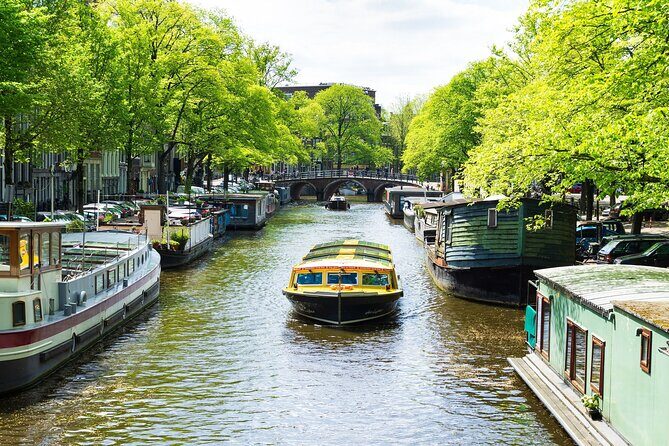
Amsterdam can eat your schedule. Between museums, bikes, and just trying not to get lost, you can burn hours fast. This cruise is built for time-stressed visitors: about 1 hour to float through key canals and landmarks while someone else handles the route.
At $18.71 per person, it is not trying to be a premium private experience. But that’s exactly the point. You’re paying for speed, coverage, and an efficient way to see Amsterdam’s canal geometry—how streets line up with waterways, where the city bends, and why certain neighborhoods feel intimate from the water.
It’s also capped at a maximum of 68 travelers. That’s large enough to feel like a real service, but small enough that most people don’t feel swallowed by crowds.
You can also read our reviews of more boat tours in Amsterdam

Meeting at Anne Frank House: location, timing, and what to expect on board
The meeting point is in front of the Anne Frank House, and it’s genuinely easy to find. If you’re doing Anne Frank the same day, this is one of those rare tours where the timing can work smoothly. You’re in central Amsterdam, near major transit, and close to other sights.
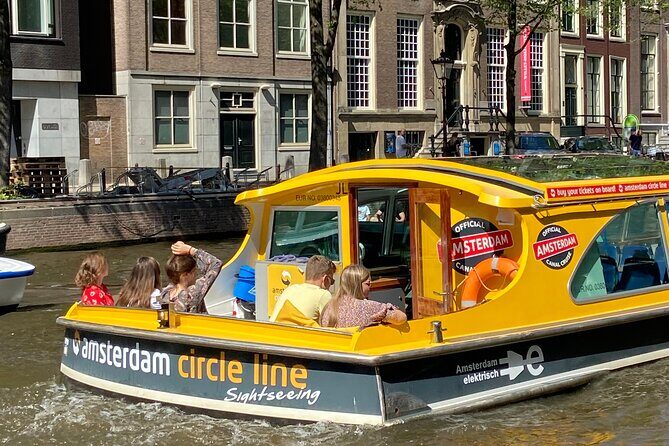
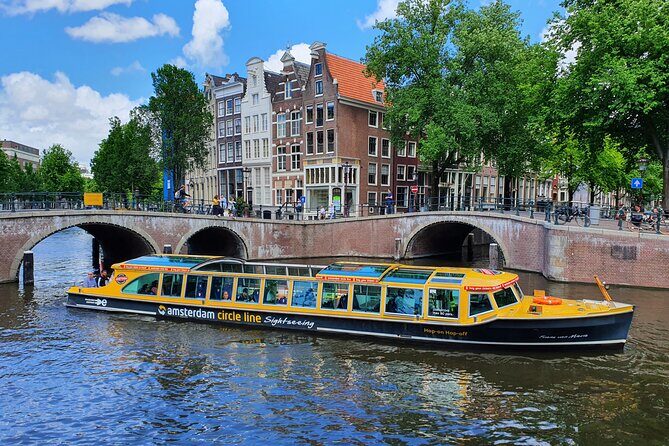
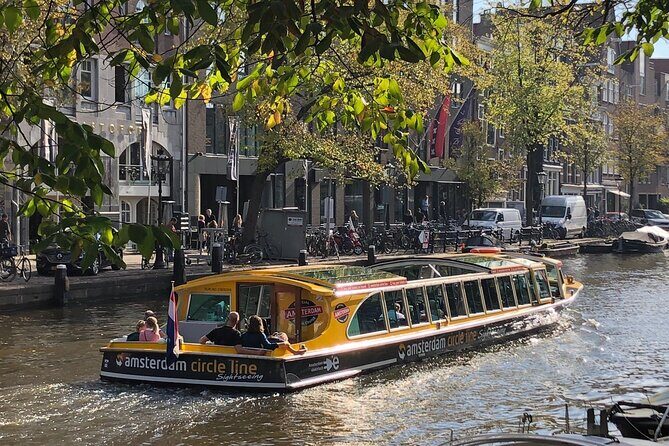
You’ll get a mobile ticket, which helps when you’re already juggling museum tickets and phone maps. Once you’re on board, expect a standard sightseeing boat setup: seating with views through windows and a glass ceiling, plus the option to stay inside or outside depending on the weather.
Audio is the main layer of the experience. The commentary is delivered through an onboard system, sometimes with language switching. That’s fine for most people, but I’d plan your seat choice like it matters, because it often does. If you want the best chance to hear, pick a spot where you’re not fighting wind, engine noise, and the audio coming from the opposite direction.
The UNESCO Canal Ring: seeing centuries in one pass
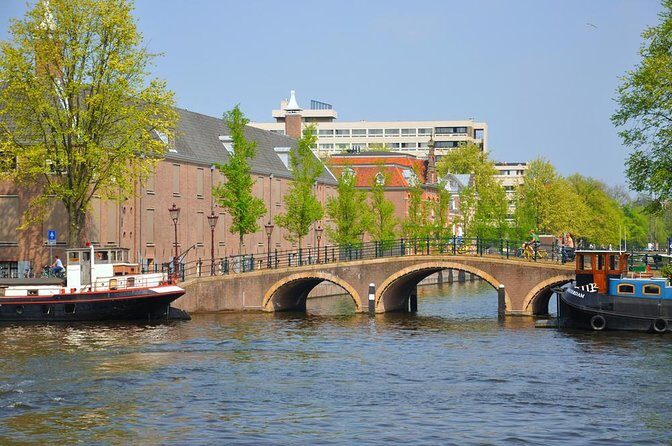
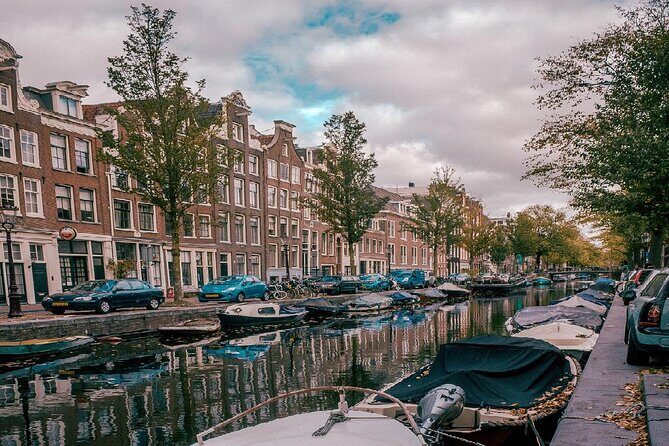
The cruise highlights Amsterdam’s UNESCO-listed Canal Ring, and that matters. A lot of people think canals are just scenery. From water, you understand they are infrastructure—transport routes, business corridors, and neighborhood boundaries.
As you float along, you’re pointed toward how the city’s canal network connects major zones. You’ll also get a sense of the city’s scale over time: the route is built to give you 400+ years of city history in a short window, from churches to opera-adjacent architecture.
One big practical benefit: you don’t have to decide what to walk to first. From the boat you can see patterns, then choose what to return to on foot after. For a first visit, that beats over-planning.
Museum of the Canals plus canal origins you can actually picture
Early on, the route frames what you’re seeing through the lens of canal history, including references to the Museum of the Canals. Even if you don’t stop inside the museum, the intro helps you connect what the boat shows you with why those canal lines matter.
You’ll want to pay attention to the canal edges: the way narrow frontages align with water, and how buildings stack along the waterline. This is the “read it fast” part of Amsterdam. The cruise doesn’t replace deeper study, but it does give you an instantly useful mental map.
If your day includes multiple museums, this is the kind of opening that prevents the city from feeling like separate stops with no connections.
Prinsengracht area landmarks: Anne Frank House and Westerkerk
This is the emotional and visual anchor of the route. Right by the canal system you’ll have the Anne Frank House, known as Anne Frank Huis, a writer’s house and wartime museum dedicated to Anne Frank.
The story is tied to the building on the Prinsengracht. During World War II, Anne and her family hid in the Secret Annex (Achterhuis), a set of hidden rooms in the rear of the 17th-century canal house. Her diary later shaped how the world remembers her story, and the Anne Frank Foundation was established to protect the property from development pressure.
From the boat, you get a calmer view—less about standing in lines, more about seeing the canal frontage in its full setting. If you’re going to do Anne Frank in depth, the cruise works as an introduction. If you’re only doing the canal tour, you’ll still understand why this part of Amsterdam hits harder than the typical photo stop.
Close by is the Westerkerk, a Reformed church within Dutch Protestant Calvinism. It sits in the western part of the canal belt neighborhood area, next to the Jordaan, between Prinsengracht and Keizersgracht. From the waterways, churches like this help you orient the center of Amsterdam: they act like vertical landmarks in a city of horizontal streets.
You can also read our reviews of more city tours in Amsterdam

Houseboat Museum on the Hendrika Maria: living on the water, made tangible
One of the most interesting “stop-by-narration” moments is the Houseboat Museum and the chance to picture real life on Amsterdam canals. The museum is in the Hendrika Maria, a former cargo ship built in 1914.
What I appreciate about this angle is that it turns the canal from scenery into housing. The cargo hold is described as a cozy living space with conveniences and surprisingly comfortable room inside. You can almost see the daily routines on the water, even though you’re still just gliding past.
Practical note: because this is a short cruise, you’ll likely get the concept more than the details. If you love canal culture, you might want to follow up with the museum itself later.
Leidsegracht, De Beulingsloot, and the canal houses that make Amsterdam feel like a maze
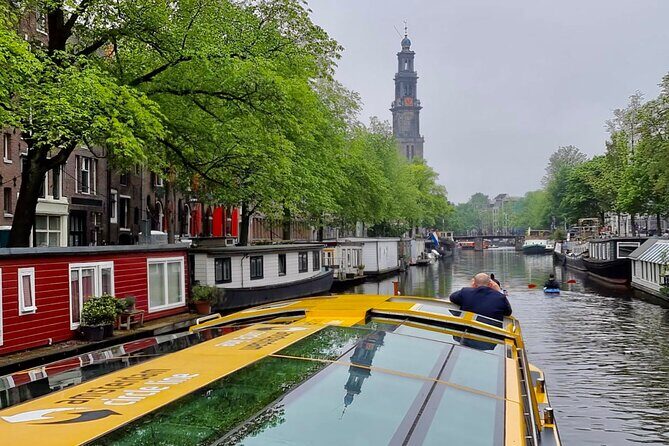
Amsterdam’s charm is partly geometry: canals intersect, streets fold in, and neighborhoods feel “sewn together” by water. The cruise includes several of these classic canal stretches:
- Leidsegracht is a cross-canal in Amsterdam-Center that links Herengracht, Keizersgracht, Prinsengracht, and Lijnbaansgracht, and flows into Singelgracht at Marnixstraat.
- De Beulingsloot is one of the oldest and shortest canals in the center, inside the Grachtengordel (canal belt).
These segments are great for photos because you get that corridor effect—rows of buildings compress toward the next bridge. It’s also helpful for orientation. After a cruise like this, you can often spot what neighborhood you’re in just by the canal shape.
Then there’s the Bartolotti House, a canal house on Herengracht 170–172, built around 1617 for Willem van den Heuvel tot Beichlingen, who inherited money through family connections involving Giovanni Battista Bartolotti, a merchant from Bologna. This kind of story is exactly what makes canal-side architecture feel more than just pretty brickwork.
If you enjoy architecture and city planning, this portion of the cruise is where you’ll feel the “I get it now” moment.
Melkmeisjesbrug: how one bridge links maps, markets, and design changes
Bridges in Amsterdam are never just bridges. They carry history, trade, and design experiments. The cruise includes the Melkmeisjesbrug, a fixed bridge in Amsterdam-Center.
There have been bridges here for centuries, and the text gives specific mapping history: people including Balthasar Florisz. van Berckenrode (1625), Joan Blaeu (1649), and Daniël Stalpaert (1662) documented it on their maps. The modern era begins in 1883, when a pedestrian drawbridge was replaced by a permanent bridge once shipping had largely ended.
Later, the bridge changed again because the passage was too narrow, and renewals in 1903 produced a design described as a paraboolligger bridge with iron sickle girders. Steel appears in the 1966 version, while still aiming to match the slender look of the street scene. The bridge name also ties to the milk market once held nearby, with a milkmaid image connected to a later catering business. And yes, it’s considered the place where the first type of Amsterdammertje was placed.
On a boat, bridges can look fast and small. But with commentary like this, you start noticing details—like how the bridge position lines up with canal narrowing and why certain crossings mattered.
Brouwersgracht, Herenmarkt, and the canal belt’s north border
Another practical geography stop is Brouwersgracht, a canal that connects Singel with Singelgracht and marks the northwestern border of the Grachtengordel. Between Prinsengracht and Singelgracht it forms the northern border of the Jordaan neighborhood.
This canal also shows how Amsterdam numbers its streets: the house number system for several major canals starts counting from Brouwersgracht. The Herenmarkt sits between Brouwersgracht no. 62 and no. 68 near the West-Indisch Huis.
There’s also a fun local detail: in 2007, Brouwersgracht was voted the most beautiful street in Amsterdam by readers of Het Parool from a pool of 150 nominations. Even if you don’t care about awards, that gives you a hint about the vibe you’re likely to see from the water—classic canal belt edges, clean lines, and strong postcard angles.
Churches with changing roles: Adriaan Dortsman’s church and the Posthoornkerk
Amsterdam churches often shift purposes over time. One church described on the route was designed by Adriaan Dortsman, opened in 1671, and then nearly destroyed in 1822 before being rebuilt in 1826. The organ was built by J Batz in 1830 and restored in 1983 by Flentrop Orgelbouw. In 1935, Lutherans left the building and it became a concert hall. A tunnel was built in 1975 by the neighboring Sonesta Hotel (today called the Renaissance Amsterdam Hotel) for access.
That story matters because it mirrors Amsterdam itself: spaces get reused, adapted, and reinterpreted. From the canal, you don’t just see a landmark—you see a city that keeps working.
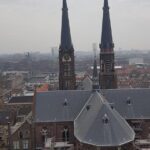
The cruise also includes the Posthoornkerk, designed by P.J.H. Cuypers and completed in phases (1860–1863 for the choir/transept/crossing tower/nave, and 1887–1889 for the two-tower front). It replaced an earlier hidden church called De Posthoorn on the Prinsengracht.
The interior uses galleries above the side aisles to make optimal use of limited space, while the exterior is neo-Gothic. The model for the interior is identified as the late Romanesque Munsterkerk in Roermond. On the boat, this gives you a different kind of “read”: you’re noticing how the exterior and interior respond to space constraints.
Amsterdam Centraal, the IJ, and EYE Filmmuseum: the modern face of the waterfront
After the older canal belt details, the cruise shifts toward the city’s modern waterfront. Amsterdam Centraal appears too, designed by Pierre Cuypers (also tied to the Rijksmuseum). The design note here is that Cuypers focused mostly on decoration while structural work is believed handled by railway engineers—again, a reminder that major buildings are collaborations.
Then there’s the IJ, described as a body of water formerly a bay and known as Amsterdam’s waterfront. This is where the city opens up. From the boat, you’ll feel the difference between tight canal corridors and broader water expanses.
The EYE Filmmuseum building is also included, designed by Delugan Meissl Associated Architects. The building has multiple gallery exhibition spaces and several cinemas (including a 300-seat cinema and smaller ones), which helps you understand why the building feels like a multi-purpose cultural machine. Even if you don’t go inside, you get the shape and purpose of the architecture from the waterline.
Amstel and Hermitage Amsterdam: museum life on the river
The cruise references the Amstel river, flowing from Nieuwveen northwards and passing through places like Amstelveen and Ouderkerk aan de Amstel before reaching the IJ in Amsterdam. The river also hosts events such as Liberation Day concert elements, rowing matches, and pride boat parades.
Then you’ll get Hermitage Amsterdam, a branch museum on the banks of the Amstel, housed in the former Amstelhof building from 1681. It’s described as a satellite of the Hermitage Museum in Saint Petersburg, Russia, with a large total area and an exhibition-focused layout across large halls and smaller rooms.
From a boat, the value of seeing Hermitage Amsterdam from the river is mostly “context.” You understand where museum culture fits into daily city life: not on a far hill, not hidden behind traffic, but right beside the water that defines the city’s movement.
The Stopera: city hall meets opera and ballet
The cruise route includes Stopera, a building complex housing both the city hall of Amsterdam and the Dutch National Opera and Ballet. The design is attributed to Wilhelm Holzbauer and Cees Dam.
The name story is practical to know because it clears up confusion: Stopera comes from the protest slogan Stop the Opera, not a blended word of city hall and opera. It also notes that the theater never used Stopera as part of its official communication.
From the water, Stopera is one of those landmarks you either love or ignore—until you connect the idea of government and performing arts living in the same complex. If you like architecture or civic design, you’ll enjoy this part because it’s not just decoration. It’s Amsterdam’s institutions, on display.
Audio commentary, languages, and hearing: how to get the most from the narration
This is the make-or-break area for many short canal cruises, and it’s worth planning for.
The cruise uses a voice-over system. I’d expect that languages can switch, and in some cases the audio might be harder to understand if you’re not near the speaker area or if you’re in a position where wind covers parts of the sound. Some riders also highlight that it can be difficult to hear the taped recording, and that language switching might not have a clean pause.
My advice: sit where you can comfortably listen without leaning. If you’re at the back, you might get a good view but struggle with audio clarity. If you’re coming in cold weather, staying inside can help because you’re less focused on wind and more on what’s being said.
On top of that, if you get an onboard captain or guide who brings energy, the cruise feels like a friendly guided loop rather than just a soundtrack. Names like Robert and Rolif show up in the kind of experiences people describe—fun, relaxed, and history mixed with humor. Your best bet is to go in ready to laugh a little and learn a little.
Weather, comfort, and simple tips that save your day
Even for a short cruise, Amsterdam weather can change the mood fast. The good news: the boat setup lets you handle it. You can move between inside and outside, and the cruise is short enough that discomfort doesn’t last forever.
If you’re planning this as part of a museum day, keep this in mind: the meeting point is near the Anne Frank House, so it can be convenient to pair the cruise with another visit nearby. It also works well at the start of your trip, when you want a mental map more than you want a deep dive.
One more tip from real-world experience: canal events can affect departures. If you’re traveling on a day with major waterway activity like the Pride parade, confirm your exact departure timing so you don’t get surprised by cancellations or rerouting. It’s rare, but it’s real.
Who should book this cruise (and who should skip it)
This is a great pick if you:
- want a first-time Amsterdam orientation in under two hours total
- like canal architecture and want it explained in English
- have limited time and don’t want to spend hours walking between districts
- want a low-effort activity that still feels like you did something meaningful
You might want to look elsewhere if you’re the type who needs a live, highly detailed guide for every landmark, because this cruise leans on audio-style narration more than constant back-and-forth. If you have hearing sensitivity issues, you should be ready to choose seating carefully or accept that you’ll catch the visuals even if the sound isn’t perfect.
Should you book Amsterdam Historic City Sightseeing Canal Cruise?
If you’re trying to fit Amsterdam into a tight schedule, I’d book this. It’s central, it’s easy to find from the Anne Frank House area, and it covers the canal ring and key landmarks in a compact 1-hour window for a straightforward price.
My call: book it if you want quick context and great water views. Skip it only if you strongly prefer live guiding for every stop or if you know you struggle with audio on boats. Either way, it’s one of the easiest ways to make Amsterdam feel legible fast—then you can spend the rest of your time where your curiosity pulls you.
FAQ
How long is the Amsterdam Historic City Sightseeing Canal Cruise?
The cruise is about 1 hour.
Where does the tour meet?
The meeting point is in front of the Anne Frank House.
Is the tour offered in English?
Yes, it is offered in English.
How much does it cost?
The price is $18.71 per person.
Do I need a mobile ticket?
Yes, the tour uses a mobile ticket.
How far in advance is it typically booked?
On average, it’s booked about 14 days in advance.
What is the maximum group size?
The maximum number of travelers is 68.
Is the meeting point near public transportation?
Yes, it’s near public transportation.
Can I get a full refund if I cancel?
You can cancel for a full refund up to 24 hours in advance of the experience’s start time.