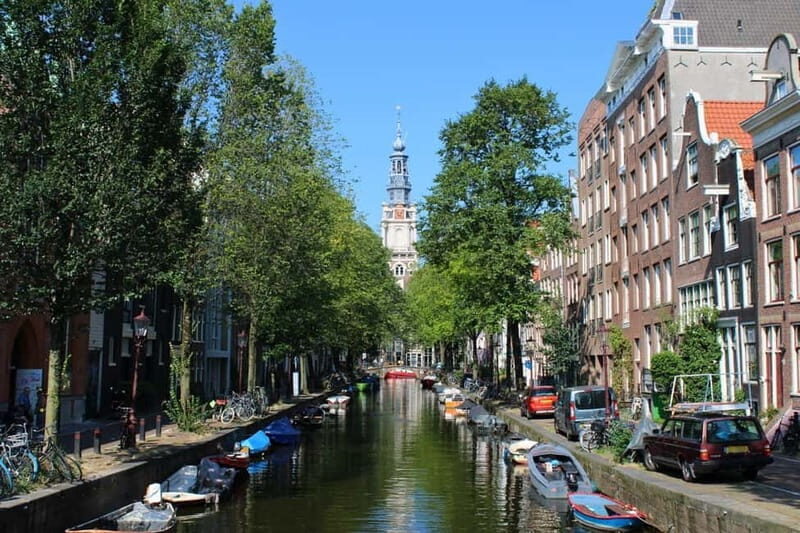
One street. One story after another. That’s the feel of this Anne Frank and WWII walking tour. You’ll trace how Amsterdam’s Jewish community lived, resisted, and was targeted during World War II, with stops tied to real places like the Portuguese Synagogue and memorials connected to deportations.
I especially like the way the guide connects details of Anne Frank and her family to what you’re seeing on the ground. I also like the pacing: it’s a 2-hour, small-group walk (up to 15 people) that leaves room for photos, questions, and a quieter kind of reflection than a rushed museum circuit. One thing to consider: this tour does not include admission to the Anne Frank House, so you’ll want to plan that separately if it’s on your must-do list.
In This Review
- Key things you should know before you go
- Walking the Jewish Quarter with context that actually sticks
- Meeting at Amstel 51C: start point, timing, and the walk style
- Portuguese Synagogue: Amsterdam’s Jewish community in the Dutch Golden Age
- Auschwitz Monument: a stark marker in the timeline
- Verzetsmuseum Amsterdam and resistance during WWII
- Hollandsche Schouwburg: deportation camps explained through a real site
- De Plantage and Spinoza Monument: seeing the neighborhood beyond the headlines
- Dam Square and Royal Palace: the story ends in the public heart of the city
- Price and value: why $29.45 can be a smart buy
- Who this tour is best for (and who might want a different option)
- Should you book this Anne Frank and WWII walking tour?
- FAQ
- How long is the Amsterdam Anne Frank and WWII walking tour?
- How much does the tour cost?
- Is Anne Frank House entrance included?
- What is included in the tour price?
- What language is the tour offered in?
- Where do I meet the guide?
- Are there any entrance fees for the stops?
- What is the cancellation policy?
Key things you should know before you go
- Small group size (max 15) keeps the tour personal and question-friendly
- Anne Frank House is not included, so don’t count on skipping that ticket
- A place-by-place route through the Jewish Quarter makes the WWII story feel grounded
- Free admission is listed for the main stops, which helps your overall budget
- Guides vary by name and style, but the tour is repeatedly praised for keeping people engaged
Walking the Jewish Quarter with context that actually sticks
Amsterdam can be confusing at street level. You’ll see canals, courtyards, plaques, and grand buildings that look timeless. What makes this tour worth your time is that it gives you a map inside the map—so the locations start telling you how people lived, what changed in the 1930s and 1940s, and what happened when persecution escalated.
This is a walking tour in an area where you can’t always tell what’s important just by looking. The route is designed to correct that. As you move from site to site, you’re not just collecting facts—you’re building a clear timeline, tied to buildings and memorials you can stand in front of.
Also, you’re not stuck in one room. The walking format creates atmosphere. It helps you slow down at the spots that deserve it, then keep going when it’s time to add the next chapter.
Meeting at Amstel 51C: start point, timing, and the walk style
You meet at Amstel 51C, 1018 EJ Amsterdam. The tour ends back at the same meeting point, so you’re not left trying to navigate the last stretch alone.
Expect about 2 hours on foot. The itinerary runs through several short stops—most are around 10 minutes each—plus walking time between them. That structure is useful because it prevents the tour from becoming either a lecture with no air, or a speed-walk with no meaning.
What helps a lot is the small group size. When the group is capped at 15 travelers, you’ll get more back-and-forth. You’re also more likely to hear the explanations clearly without strain. And since the tour is offered in English, you won’t have to hunt for translations or guess at what you’re looking at.
Practical tip: wear comfortable shoes. This is not a casual stroll. It’s a “pay attention and keep moving” walk, and you’ll cover enough ground that tired legs can cut your attention span.
Portuguese Synagogue: Amsterdam’s Jewish community in the Dutch Golden Age
The tour begins at the Portuguese Synagogue. Even if you’ve only read a few pages of Anne Frank’s story, this first stop matters because it widens your view. You’re not starting with tragedy. You’re starting with community.
Here, you’ll learn how the Sephardic Jewish community became one of the largest and richest Jewish communities in Europe during the Dutch Golden Age, and how that prosperity showed up in the synagogue itself. The synagogue remains an active place of worship, which changes how you experience it. You’re not only looking at history—you’re seeing something living.
Why it’s valuable: in many WWII narratives, the Jewish story starts after the persecution begins. This tour starts earlier, so later events hit with more weight. You’re reminded that real people had routines, culture, and community before the world narrowed.
Auschwitz Monument: a stark marker in the timeline
Next comes the Auschwitz Monument. The emphasis here is on the monument and Jewish deportation. This is one of those stops where you’ll want a moment to absorb the gravity, rather than rush for the next photo.
Since the stop is short (about 10 minutes), the guide’s job is to frame what the marker represents and how it connects to the broader WWII story. I like this structure: quick on time, but not quick on meaning.
Consideration: if you’re sensitive to WWII/Holocaust content, give yourself permission to go slowly at this and other memorial-related stops. The tour’s pace is designed to keep you moving, but you can pause longer if you need to.
Verzetsmuseum Amsterdam and resistance during WWII
After the Auschwitz Monument, the tour heads to Verzetsmuseum Amsterdam. The focus is on Jewish resistance.
This is an important shift in the emotional arc. Deportations and imprisonment are only one side of what happened. Resistance shows another truth: people tried to protect one another, and communities weren’t only victims—they were also agents who made choices under extreme pressure.
Why this matters for you: if Anne Frank is the entry point for your learning, this stop helps you understand her world wasn’t only hiding. It included networks, risk, and difficult decisions. Even in a short walking stop, you’ll come away with a less one-dimensional picture.
Hollandsche Schouwburg: deportation camps explained through a real site
The next stop is Hollandsche Schouwburg, described here in connection with deportation camps. This part of the tour is hard, but it’s also where the facts start to become unavoidably concrete.
You’ll get context about what the site represents and how the deportation system shaped everyday life. The guide’s framing is key because the building’s significance isn’t obvious at street level. Without context, it’s easy to read it as just another historic structure. With context, it becomes part of a specific mechanism of persecution.
Practical note: the time at each stop is brief, so it helps to listen closely and ask questions if something isn’t clear. If you want more depth, keep that Anne Frank House ticket separate—this tour is the broader framework around her story.
De Plantage and Spinoza Monument: seeing the neighborhood beyond the headlines
Next you’ll reach De Plantage, a beautiful area with its own history. The tour then includes the Spinoza Monument, which ties the intellectual and cultural legacy of the community into the walking route.
These stops can feel different from the memorial sites because they give your brain a place to breathe. That matters, because the emotional tone of WWII content can otherwise become flat from repetition. Here, you’re allowed to see the neighborhood as more than a set of tragic landmarks.
Why you’ll likely appreciate this section: you start to understand why Anne Frank and her family were embedded in a real city, not a fictional backdrop. Even if you’re thinking about one diary, you’re watching how the city held layers—people, ideas, streets, and change.
Dam Square and Royal Palace: the story ends in the public heart of the city
After Spinoza Monument, you’ll walk toward Dam Square and the Royal Palace area. This isn’t a random detour. It’s where the tour gives you contrast: the Jewish Quarter’s WWII narrative lands in one of Amsterdam’s most central public spaces.
At Dam Square, you’ll explore the square’s monument (and the guide will connect this final leg back to the overall story you’ve been building). You’ll then stop at De Schaduwkade.
How to think about the ending: it’s a way to take the history with you out into the city you came to see. You finish the tour with context you can carry into museums, canal walks, and your own reading of Anne Frank’s diary.
Practical tip: since this is your final stretch, it’s a good time to check what you want to do next—especially if Anne Frank House is still on your plan for the day or the next morning.
Price and value: why $29.45 can be a smart buy
At $29.45 per person for about 2 hours, this tour sits in the low-to-mid range for Amsterdam guided experiences. The value comes from how the tour is built:
- You get a local guide who ties multiple WWII-era locations into one storyline.
- The itinerary includes several stops marked with free admission tickets, which helps you avoid budget surprises.
- Group size is limited to 15, so you’re not stuck listening to a guide from far away.
Also, the tour is built to fit a short visit. If you’re doing Anne Frank House and other sites, you might not have time to build a full Jewish Quarter context on your own. This is a fast way to get that context without turning your trip into a homework assignment.
One caution on value: because Anne Frank House is not included, you’re really paying for the wider setting, not the museum experience itself. If Anne Frank House is your only goal, you may still want this tour for context—but budget and tickets for the House separately.
Who this tour is best for (and who might want a different option)
This experience is a strong match if you want:
- A guided walking framework for Anne Frank and WWII in Amsterdam
- A route through the Jewish Quarter that connects multiple key sites
- A format that supports questions, especially in a group of 15
It can also work well for adults who like history but don’t want a long museum day.
You might want to think twice if:
- You’re traveling with young kids who won’t handle a “keep moving” pace well (this is a walk tour with enough distance to wear people out).
- You expected Anne Frank House admission based on the title. The tour focuses on the surrounding story and sites; the House itself requires separate planning.
If you’re a first-timer to Amsterdam, I’d still recommend it. It gives you grounding before you start chasing canals and museums. If you’re a return visitor, it adds depth to places you may have passed without understanding.
Should you book this Anne Frank and WWII walking tour?
If you’re deciding whether your Amsterdam time should include a guided Jewish Quarter walk, I’d say this one is worth serious consideration. The route makes sense: it starts with the Portuguese Synagogue, moves through WWII memorial and resistance sites, covers deportation-related places, and ends at Dam Square so you’re not trapped in one theme all day.
Book it if:
- You want the Anne Frank story framed inside the wider Amsterdam WWII experience
- You like small-group walking tours with time for questions and photos
- You’re okay planning Anne Frank House separately
Skip or reconsider if:
- You need the Anne Frank House itself included
- You want a lighter, less intense pace
If you do book, plan comfortable footwear, bring your curiosity, and treat each stop like part of one evolving timeline. That’s when this tour delivers its best payoff.
FAQ
How long is the Amsterdam Anne Frank and WWII walking tour?
It runs for approximately 2 hours.
How much does the tour cost?
The price is $29.45 per person.
Is Anne Frank House entrance included?
No. The tour specifically notes that an entrance ticket to Anne Frank House is not included.
What is included in the tour price?
A local guide is included.
What language is the tour offered in?
The tour is offered in English.
Where do I meet the guide?
The meeting point is Amstel 51C, 1018 EJ Amsterdam, Netherlands.
Are there any entrance fees for the stops?
The listed stops show admission ticket free for the stops included in the walking route. Anne Frank House entrance is not included.
What is the cancellation policy?
You can cancel for a full refund up to 24 hours before the experience start time.